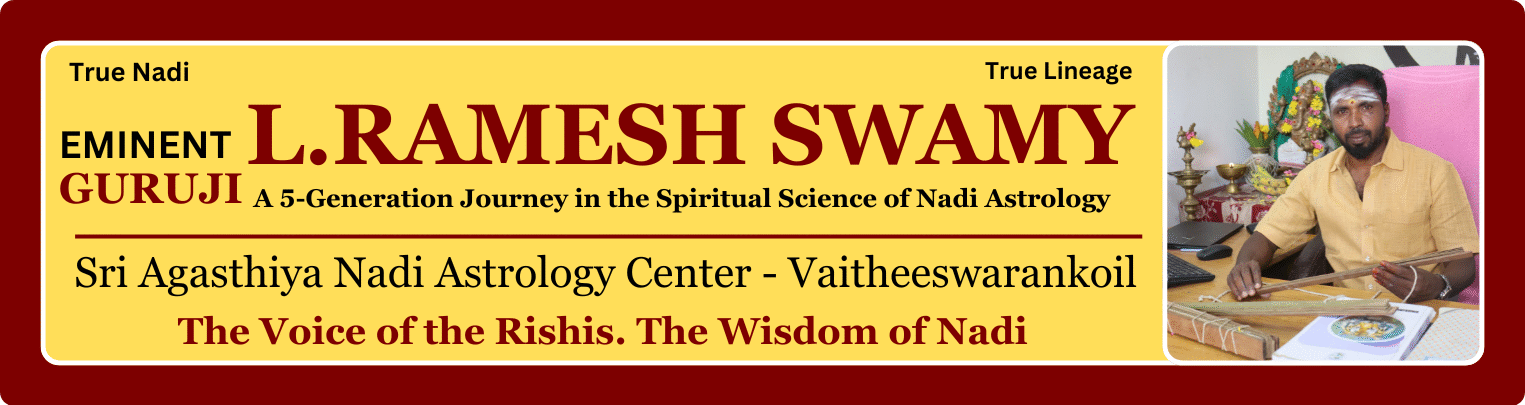

For centuries, palm leaves served as an important writing material in different parts of India. Long before modern printing and digital storage became available, knowledge relating to philosophy, medicine, literature, mathematics, spirituality, rituals, astronomy and other subjects was recorded on specially prepared leaves.
Within the tradition known as Nadi Astrology, palm leaf manuscripts are associated with astrological readings passed down through generations. Today, interest in Nadi palm leaf reading continues in places such as Tamil Nadu, particularly around Vaitheeswaran Koil.
But one fascinating question remains: How can such old palm leaves survive for generations, and how are they read today?
The answer involves a combination of traditional preservation, careful handling, manuscript conservation and specialized knowledge of old scripts.
What Are Nadi Palm Leaf Manuscripts?
Palm leaf manuscripts are made from processed leaves of suitable palm species. After preparation, the leaves provide a flat surface on which information can be written or incised.
Traditionally, characters were often engraved into the surface with a pointed writing instrument rather than simply written using an ordinary pen. The text could then be made more visible by applying suitable darkening material so that the letters stood out from the leaf.
Individual leaves were generally arranged together, often with holes through which a cord could pass. Protective boards or covers could be placed above and below the bundle.
The result was not a modern bound book but a collection of long, narrow manuscript leaves.
Why Do Palm Leaves Require Special Preservation?
Palm leaf is an organic material. This means that environmental conditions can gradually damage it.
Some of its greatest enemies include:
- excessive humidity and moisture
- insects and pests
- fungal growth
- dust and dirt
- direct sunlight
- excessive heat
- careless handling
- fire and water damage
- repeated bending or friction
Over time, a leaf may become brittle, cracked, stained or difficult to read.
This is why preservation is extremely important. India’s manuscript conservation institutions use both preventive conservation and curative conservation to protect manuscript collections for future generations.
1. Keeping the Palm Leaves Clean
One of the most basic preservation practices is regular, gentle cleaning.
Dust that remains on a manuscript for long periods can attract moisture and insects and may gradually affect the surface of the leaf.
Palm leaves therefore need to be handled carefully and cleaned without aggressive rubbing.
Professional manuscript guidelines recommend soft cleaning materials and controlled handling rather than harsh household cleaning products.
The objective is simple: remove harmful surface contamination without damaging the original writing or leaf fibres.
2. Protection from Moisture and Humidity
Humidity is one of the most serious concerns in manuscript preservation.
Palm leaves should not be stored in damp rooms or directly beside windows where changing weather conditions may introduce moisture, heat and dust.
At the same time, extremely dry conditions can also make old leaves brittle.
Modern conservation therefore pays close attention to temperature, relative humidity and air circulation.
Professional manuscript repositories may use monitored storage environments so that sudden changes in moisture and temperature do not accelerate deterioration.
3. Traditional Oils and Natural Protective Methods
Indian manuscript traditions have also used natural materials in caring for palm leaves.
Depending on the region and manuscript tradition, substances associated with neem, eucalyptus, clove and other plant materials have historically been used as part of manuscript care or insect-deterrent practices.
However, preservation should not mean applying random oils or chemicals to an old manuscript.
A valuable historical manuscript can be permanently damaged by an unsuitable treatment. Today, fragile manuscripts are best examined by trained conservators before any restorative substance is applied.
Traditional knowledge and modern conservation therefore increasingly work together.
4. Protecting Manuscripts from Insects
Palm leaves can attract insects because they are made from natural organic material.
Traditional storage areas therefore paid considerable attention to keeping pests away from manuscript bundles.
Natural insect-deterring materials have historically included substances such as neem leaves and other plant-based materials.
Modern conservation centres use more systematic methods, including clean storage areas, regular inspection, environmental control and professional treatment when an infestation is discovered.
Preventing insects is far safer than attempting to repair a manuscript after sections of the leaf have already been eaten away.
5. Bundling and Safe Storage
Palm leaf manuscripts traditionally consist of multiple leaves arranged in sequence.
Correct arrangement is essential because a misplaced leaf may interrupt the meaning of the text.
Manuscripts may therefore be kept as carefully organized bundles, traditionally protected between covers and wrapped for storage.
Modern conservation guidance also recommends protective supports and suitable wrapping materials.
The manuscripts should not simply be piled carelessly on the floor or compressed beneath heavy objects.
Every bundle needs enough protection to reduce physical stress while remaining accessible when it must be examined.
6. How Are Old Nadi Palm Leaves Read?
Preservation is only half the story.
The next challenge is deciphering what is written on the manuscript.
Many old palm leaf records use historical forms of regional scripts and writing styles. Characters can look very different from modern printed letters.
A traditional reader therefore requires familiarity with:
- old handwriting styles
- regional scripts
- astrological terminology
- abbreviations
- traditional vocabulary
- manuscript organization
- interpretation methods passed through a particular lineage
Reading a palm leaf is therefore different from reading an ordinary modern Tamil book.
Experience plays an important role in recognizing faded characters and understanding the context in which particular expressions were used.
7. How Is a Leaf Identified in Nadi Astrology?
In many contemporary Nadi Astrology traditions, the search for a person’s reading begins with a thumb impression.
Traditionally, the right thumb impression is commonly taken for men and the left thumb impression for women.
The fingerprint pattern is then used as part of a classification system to narrow the collection of manuscript bundles that may need to be examined.
A Nadi reader may read identifying statements from candidate leaves and ask the visitor to confirm whether those details correspond to their life.
This process may continue through several leaves or bundles until a manuscript considered to match the seeker is identified.
It is important to understand that this procedure belongs to the traditional practice and belief system of Nadi Astrology; it should not be confused with a scientifically established method of personal identification.
8. Translating the Palm Leaf for Modern Visitors
Even when a manuscript can be read by a trained reader, many visitors cannot understand the older script or terminology directly.
The practitioner therefore commonly reads the original text and explains its meaning in a language familiar to the visitor.
Depending on the centre, readings may be explained in Tamil, English or other Indian languages.
Modern technology has made this process more convenient. Some consultations can include audio recordings, video communication or digital notes so that visitors can review the explanation later.
9. Digitization Is Helping Preserve Manuscript Heritage
One of the most important developments in manuscript preservation is digitization.
High-resolution photography and scanning can create a digital record of fragile manuscripts.
Digitization has several advantages.
Researchers can study a digital copy without repeatedly handling the original leaf. If physical deterioration occurs later, an image of the earlier condition may still survive. Digital cataloguing can also help institutions organize large manuscript collections.
The National Mission for Manuscripts recognizes digitization alongside preservation of originals and microfilming as important approaches to conserving India’s manuscript heritage.
Technology does not replace the ancient manuscript. Instead, it can help reduce unnecessary physical handling and preserve the information recorded on it.
10. Traditional Knowledge Meets Modern Preservation
The survival of ancient palm leaf manuscripts demonstrates the importance of continuous care.
Earlier generations relied mainly on traditional knowledge concerning storage, wrapping, cleaning and protection from insects. Today, conservators can combine these practices with scientific monitoring, specialist restoration, archival storage and digitization.
Institutions across India continue to conserve palm leaf collections, including manuscript conservation centres and libraries with significant historical holdings.
This combination of traditional care and modern conservation science offers the best opportunity for fragile palm leaves to survive for future generations.
The Continuing Importance of Nadi Palm Leaf Reading
Nadi Astrology attracts people because it connects an ancient manuscript tradition with questions about personal life and destiny.
For visitors to places such as Vaitheeswaran Koil, seeing a traditional palm leaf manuscript can itself be a remarkable experience. The leaves represent not only an astrological tradition but also part of India’s wider manuscript heritage.
Preserving them requires patience, expertise and respect for the physical material.
Reading them requires another form of knowledge—the ability to recognize old scripts, understand traditional terminology and interpret the manuscript according to the practice followed by the reader.
Conclusion
Ancient Nadi palm leaves have survived through a combination of careful storage, protection from moisture and insects, traditional preservation knowledge and, increasingly, professional conservation methods.
Today, the process is also supported by modern technologies such as digital photography, scanning, cataloguing and recorded consultations.
At the same time, traditional Nadi readers continue the practice of identifying, reading and interpreting palm leaves according to methods handed down within their traditions.
The meeting of ancient palm leaf manuscripts, traditional Nadi Astrology and modern preservation technology allows this unusual cultural practice to remain accessible in the twenty-first century.
For anyone interested in Nadi Astrology, Agasthiya Nadi, palm leaf reading or Vaitheeswaran Koil, understanding how these manuscripts are preserved adds another dimension to the experience. Behind every surviving palm leaf is not merely a written text, but generations of careful handling and an ongoing effort to preserve India’s manuscript heritage.