Can Agastya Nadi Astrology Predict Your Future?

Can Agastya Nadi Astrology Predict Your Future?

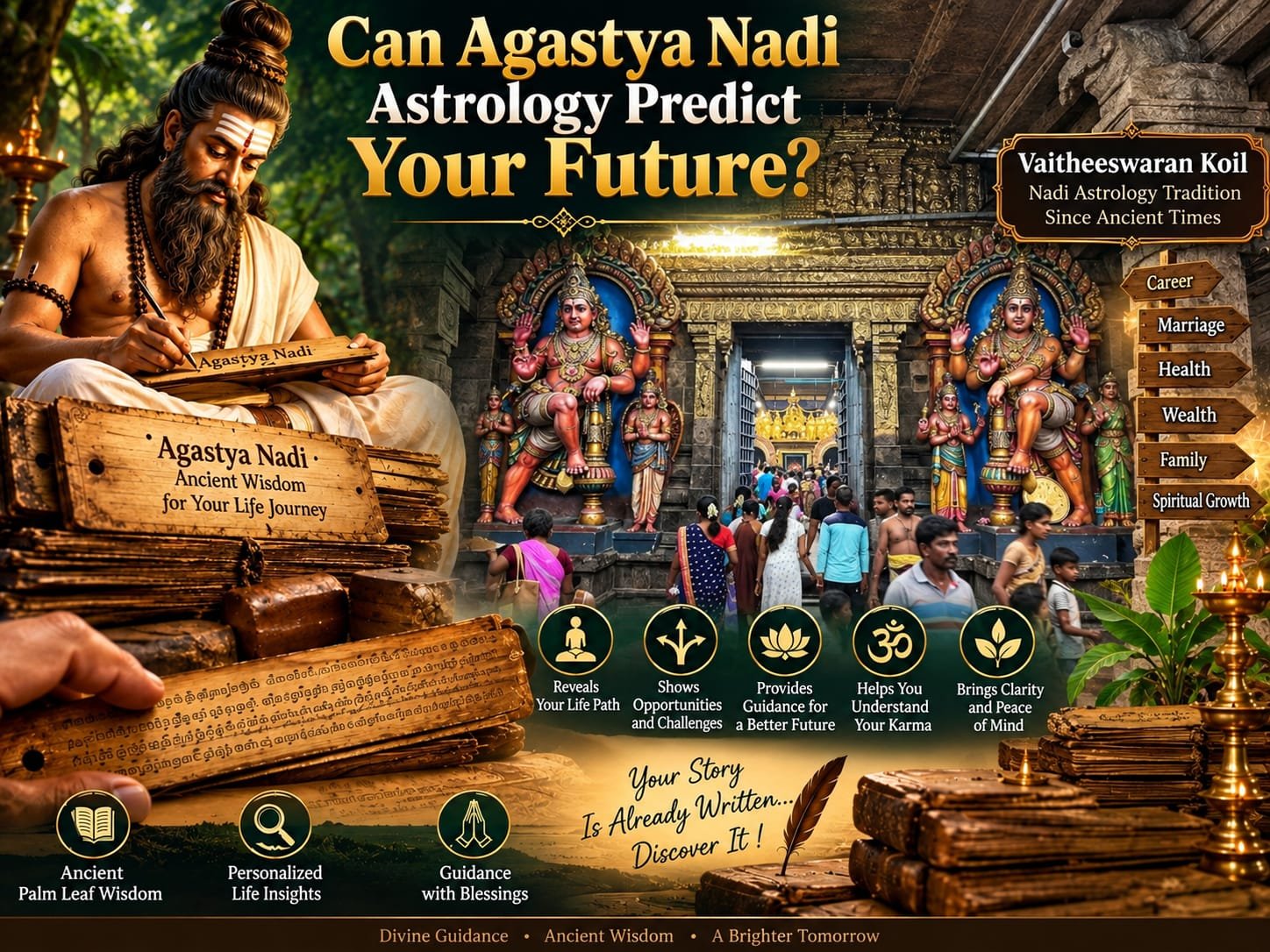
Agastya Nadi Astrology is an ancient spiritual tradition associated with palm-leaf manuscripts and the wisdom attributed to Sage Agastya. For people who approach this tradition, the idea of “predicting the future” is not simply about being told exactly what will happen tomorrow or receiving a fixed timetable for every event in life. Instead, a Nadi reading is traditionally understood as a way of exploring a person’s life journey, including possible patterns connected with family, education, career, marriage, finances, relationships, responsibilities, spiritual interests, and important turning points. According to the tradition, information was recorded on palm leaves for particular individuals, and the process of finding a relevant leaf may begin with details such as a thumb impression, followed by a series of identification questions. Once a matching manuscript is believed to have been identified, the reader interprets the material contained in the leaf and explains its traditional meaning. This is why many people see Agastya Nadi Astrology not merely as fortune-telling, but as a form of traditional guidance that encourages reflection on the direction of their lives.

One of the most interesting ideas within Nadi Astrology is the relationship between destiny and personal choice. A prediction does not necessarily have to be understood as an unavoidable event carved permanently into the future. Life is influenced by many factors, including our decisions, opportunities, relationships, circumstances, education, effort, and unexpected events. From a spiritual perspective, Nadi Astrology is often connected with the concept of karma—the idea that actions and their consequences may shape a person’s experiences. A traditional reading may therefore describe certain tendencies or periods that are considered significant while also encouraging the individual to think carefully about how they respond to those circumstances. In this sense, a Nadi reading can be approached as a map rather than an unchangeable command. A map may suggest possible directions, but the traveller still has to make choices along the journey.

The ancient palm leaves are central to the identity of this tradition. Historically, palm leaves were widely used as writing materials in South India, and manuscripts containing subjects such as literature, medicine, philosophy, religion, astronomy, and astrology were preserved in this form. Nadi Astrology developed within this broader manuscript culture and became particularly associated with certain centres in Tamil Nadu. Vaitheeswaran Koil is especially well known in popular Nadi traditions, where visitors have long sought palm-leaf readings. The atmosphere surrounding the practice—old manuscripts, traditional methods of identification, spiritual symbolism, and generations of readers—gives Nadi Astrology its distinctive character. For believers and visitors, discovering a manuscript believed to correspond to their life can feel deeply personal. However, the historical existence of palm-leaf manuscripts should be distinguished from scientifically demonstrating that a particular manuscript can reliably predict an individual’s future.

A traditional Nadi consultation may cover several areas of life rather than concentrating on one question. Career may be discussed in terms of professional direction, responsibilities, changes, or periods of opportunity. Marriage and family discussions may focus on relationships and household life. Financial sections may describe periods traditionally interpreted as favourable or challenging. Other parts may concern education, property, travel, parents, children, or spiritual development. Some Nadi traditions divide readings into sections commonly called Kandams, with each section focusing on particular aspects of life. The exact structure and interpretation can vary depending on the tradition and practitioner. For this reason, two consultations should not automatically be expected to follow precisely the same procedure or produce identical interpretations.

When someone asks whether Agastya Nadi Astrology can truly predict the future, it is useful to separate traditional belief from scientifically established evidence. Astrology, including Nadi Astrology, has not been scientifically demonstrated to predict individual future events reliably. Therefore, statements from a reading should not be treated as guaranteed facts. This distinction does not prevent someone from exploring the practice for cultural, spiritual, historical, or personal reasons. It simply means that predictions should be understood within the belief tradition from which they come. Important decisions involving medical treatment, education, money, legal matters, marriage, or employment are better made using reliable information, appropriate professional advice, and the individual’s own judgment rather than depending solely on an astrological prediction.

Another reason people are attracted to Nadi Astrology is the opportunity for self-reflection. Sometimes hearing a structured account of themes such as responsibility, relationships, goals, difficulties, and personal growth encourages a person to examine their life from a different perspective. A reading may prompt questions such as: What direction am I currently following? Which responsibilities have I been avoiding? What opportunities should I prepare for? Which relationships deserve more attention? What habits could I improve? These questions can have value even when the predictions themselves are treated cautiously. In this way, the experience may become less about waiting for destiny to arrive and more about considering how present choices can influence future possibilities.

The concept of karma also gives Agastya Nadi Astrology a strongly spiritual character. Within Indian philosophical traditions, karma is generally connected with actions and consequences, although different traditions explain it differently. In Nadi practice, interpretations may connect present circumstances with karmic themes and may sometimes include traditional spiritual recommendations. These should be understood as religious or cultural practices rather than scientifically proven methods for changing future events. For someone who follows the tradition, such practices may carry devotional significance and provide a sense of discipline, reflection, or spiritual connection. For someone approaching Nadi Astrology primarily from a historical or cultural perspective, the same elements can be understood as part of the heritage surrounding the practice.

The enduring appeal of Agastya Nadi Astrology may therefore come from something broader than prediction alone. It brings together ancient manuscript culture, astrology, spirituality, ideas about karma, personal storytelling, and the human desire to understand what may lie ahead. The image of an old palm leaf containing information connected to an individual’s journey naturally creates curiosity. People often want certainty about their career, relationships, family, finances, and future, especially during periods of change. Nadi Astrology offers a traditional framework through which those uncertainties can be explored, while modern understanding reminds us that the future cannot be guaranteed through an astrological reading.

Ultimately, the question “Can Agastya Nadi Astrology Predict Your Future?” has two different answers depending on the perspective being considered. Within the Nadi tradition, practitioners and believers may regard palm-leaf readings as revealing aspects of destiny, karma, and possible future developments. From a scientific standpoint, there is not reliable evidence establishing Nadi Astrology as a method capable of accurately predicting an individual’s future. A balanced approach is therefore to appreciate its cultural and spiritual significance without treating every prediction as certain. The future is affected by circumstances that cannot always be anticipated, but it is also shaped by choices made in the present. A Nadi reading may offer a traditional story about where the road could lead; the responsibility for deciding how to travel that road remains with the individual.
Why Do People Consult Agastya Nadi Astrology?

Why Do People Consult Agastya Nadi Astrology?

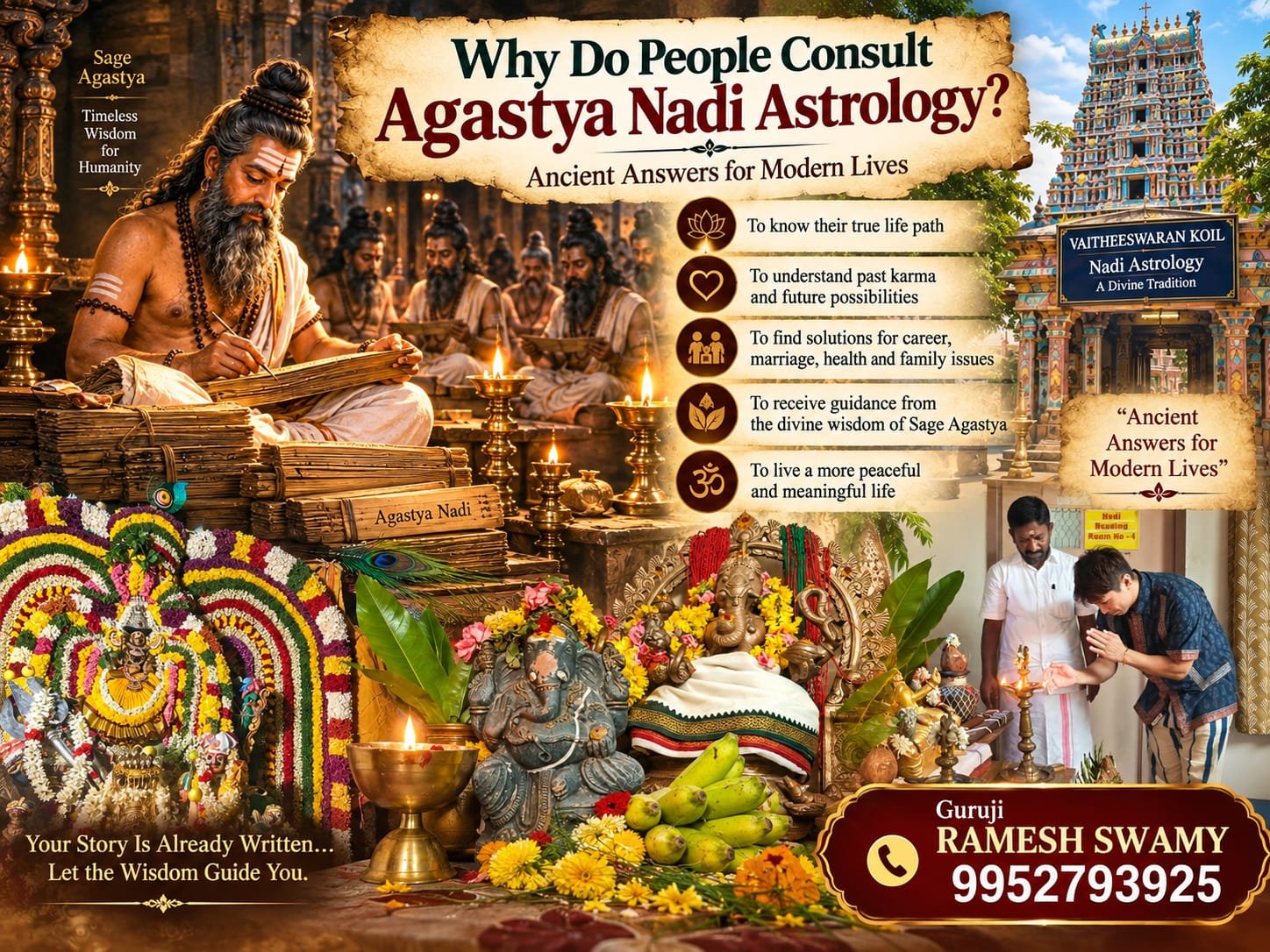
Agastya Nadi Astrology continues to attract people because it represents a distinctive spiritual tradition in which ancient palm-leaf manuscripts are consulted for guidance about an individual’s life journey. For many visitors, a Nadi consultation is not simply about asking what may happen tomorrow; it is an opportunity to reflect on their past experiences, present responsibilities, personal choices, family relationships, career direction, and hopes for the future. The tradition is closely associated with the wisdom attributed to Sage Agastya and other Siddhars, whose teachings are believed by followers to have been preserved through generations on palm leaves. When people arrive for a Nadi reading, they may come with very different questions. One person may be uncertain about career decisions, another may want greater clarity about marriage or family life, while someone else may simply be curious about the traditional idea of karma and how earlier actions are believed to influence present circumstances. This variety of personal questions is one reason Agastya Nadi Astrology continues to hold cultural and spiritual interest.

A particularly fascinating part of the tradition is the process of searching for a corresponding palm leaf. Traditionally, a thumb impression is used as part of a classification method that helps narrow the search among groups of preserved manuscripts. The reader may then examine possible leaves and ask a sequence of identifying questions. According to the traditional practice, the purpose of these questions is to determine whether a particular manuscript corresponds with the person who has come for the consultation. This creates an experience that feels very different from simply reading a general horoscope. The consultation develops gradually through questions, confirmation, interpretation, and discussion. For believers, discovering a matching leaf can carry deep spiritual meaning. For others, the experience may be approached primarily as an exploration of an old Tamil manuscript tradition. Either way, the process itself is often one of the main reasons people become interested in Nadi Astrology.

The connection between Nadi Astrology and Vaitheeswaran Koil also gives the tradition a strong sense of place and heritage. The area has long been associated with palm-leaf astrology practitioners, and visitors may encounter bundles of carefully preserved manuscripts, traditional lamps, devotional symbols, temples, and reading spaces that reflect the cultural environment in which the practice has been maintained. Palm leaves are more than decorative objects within this tradition. They represent a historical method of recording knowledge in South India, where prepared leaves were used for writing long before modern paper became common. Seeing these manuscripts can therefore create a sense of connection with an earlier period of learning and preservation. A consultation can bring together manuscript culture, oral explanation, devotional customs, family traditions, and personal reflection in a single experience.

People also consult Agastya Nadi Astrology when they reach an important turning point in life. Decisions involving education, employment, business, marriage, relocation, family responsibilities, or long-term goals can sometimes leave a person uncertain about which direction to consider. In such situations, some people seek traditional forms of guidance alongside their own practical decision-making. A Nadi reading may provide themes for reflection, but major life choices are still best considered using reliable information, personal circumstances, professional advice where appropriate, and one’s own judgment. Astrology is a traditional belief system rather than a scientifically established method for predicting individual future events. Understanding that distinction allows someone to appreciate the cultural and spiritual character of Nadi Astrology without treating every interpretation as guaranteed fact.

Another reason people are drawn toward this tradition is the concept of karma. In Agastya Nadi teachings, karma is commonly discussed as a relationship between actions, responsibilities, consequences, and personal development. Rather than thinking about destiny only as a fixed destination, many followers interpret a reading as an invitation to examine how they are living in the present. Questions such as “What responsibilities am I avoiding?”, “What patterns keep appearing in my life?”, “How can I make wiser decisions?”, or “What should I learn from earlier experiences?” can turn a consultation into a moment of self-reflection. From this perspective, the value that a person finds in the reading may come not only from statements about the future but also from the opportunity to think carefully about current behaviour and priorities.

Family history is another important element. People often become curious about Nadi Astrology after hearing stories from parents, grandparents, relatives, or friends who previously visited a traditional reading centre. A younger generation may then want to experience the process for themselves. In this way, interest in palm-leaf astrology can travel from one generation to another through personal stories rather than textbooks. The sight of an old manuscript bundle, the careful handling of individual leaves, the sound of passages being read and interpreted, and the devotional surroundings can make the consultation feel connected to a living cultural practice rather than merely an abstract idea.

Some visitors are especially interested in the traditional chapters, often called Kandams, associated with different areas of life. Depending on the tradition and manuscript being consulted, these sections may address themes such as general life circumstances, family, education, profession, marriage, children, spiritual interests, or other aspects of personal experience. People may therefore approach a consultation with one particular subject in mind rather than seeking answers about everything. A responsible approach is to listen carefully, ask questions when something is unclear, and distinguish symbolic or faith-based interpretations from information that requires professional expertise. For example, decisions involving health, law, finances, or other high-impact matters should rely on qualified professionals rather than astrology alone.

The atmosphere surrounding a traditional Nadi consultation can also be meaningful to visitors. Oil lamps, flowers, sacred imagery, palm-leaf bundles, devotional practices, and references to Sage Agastya can create a setting that encourages quiet reflection. Some people value this spiritual atmosphere as much as the reading itself. They may see their visit as a chance to move away temporarily from everyday pressures and consider their lives from a broader perspective. In a world where many decisions are made quickly, a traditional consultation may offer a slower experience built around listening, questioning, interpretation, and contemplation.

At the centre of this experience is communication between the reader and the visitor. A good consultation should allow the person to understand what is being read, ask reasonable questions, and receive explanations in accessible language. Traditional terminology can sometimes be unfamiliar, particularly to first-time visitors, so clear interpretation matters. At a centre associated with Guruji Ramesh Swamy – 9952793925, visitors interested in the tradition may seek information about the palm-leaf identification process and how a Nadi reading is conducted. As with any spiritual service, people can benefit from asking beforehand about the process, expected fees, duration, and what information will be requested, so they can decide comfortably whether the consultation is suitable for them.

Ultimately, people consult Agastya Nadi Astrology for many different reasons: curiosity about an ancient palm-leaf tradition, interest in Sage Agastya and Siddhar teachings, questions about personal direction, a desire to understand traditional ideas about karma, family influence, cultural heritage, or simply the wish to experience a practice connected with Vaitheeswaran Koil. Different visitors may interpret the experience differently. One may approach it with deep faith, another with cultural curiosity, and another as an opportunity for personal reflection. What connects these perspectives is the enduring fascination of the palm leaf itself—a simple natural material that has become a symbol of preserved knowledge across generations. Agastya Nadi Astrology therefore remains meaningful to its followers not merely because it speaks about destiny, but because it brings together ancient manuscript heritage, spirituality, personal questions, and reflection on the choices people make in their lives.

Understanding the Traditional Nadi Leaf Identification Process

Understanding the Traditional Nadi Leaf Identification Process?

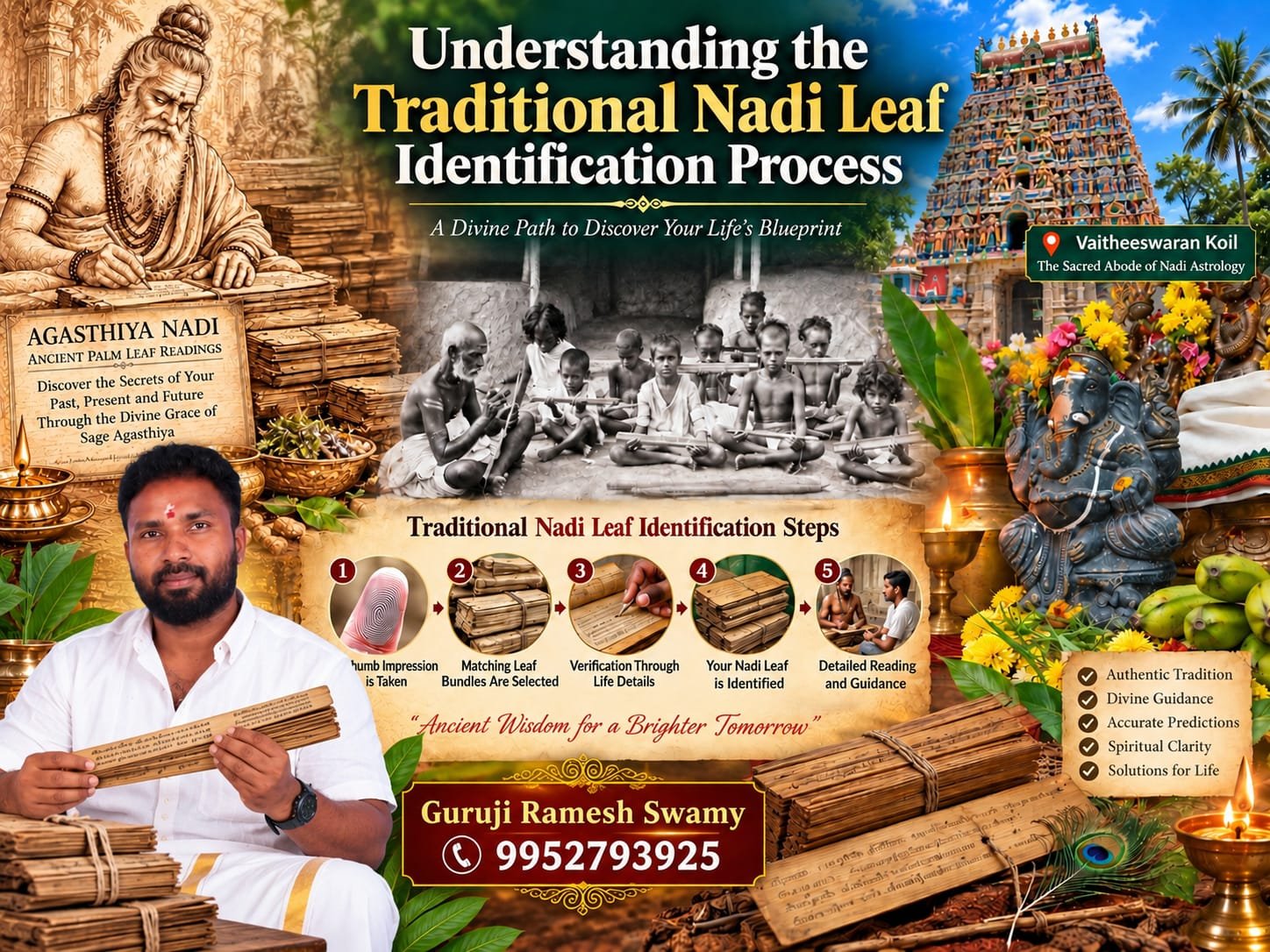
The traditional Nadi leaf identification process is one of the most distinctive parts of Nadi Astrology because the journey does not usually begin by simply opening a palm leaf and reading it. It begins with a careful search intended to identify a manuscript traditionally associated with the individual who has come for a reading. For someone experiencing this tradition for the first time, the process can feel unfamiliar, but when it is explained in simple steps, it becomes much easier to understand. Nadi Astrology is closely connected with ancient palm-leaf manuscripts and traditions associated with sages such as Agastya. These manuscripts are traditionally believed to contain observations and guidance concerning different areas of human life. The identification process is therefore treated as an important stage before the main reading begins. Rather than assuming that every bundle of leaves belongs to every visitor, the reader follows a method of narrowing down the available manuscripts until a possible matching leaf is found.
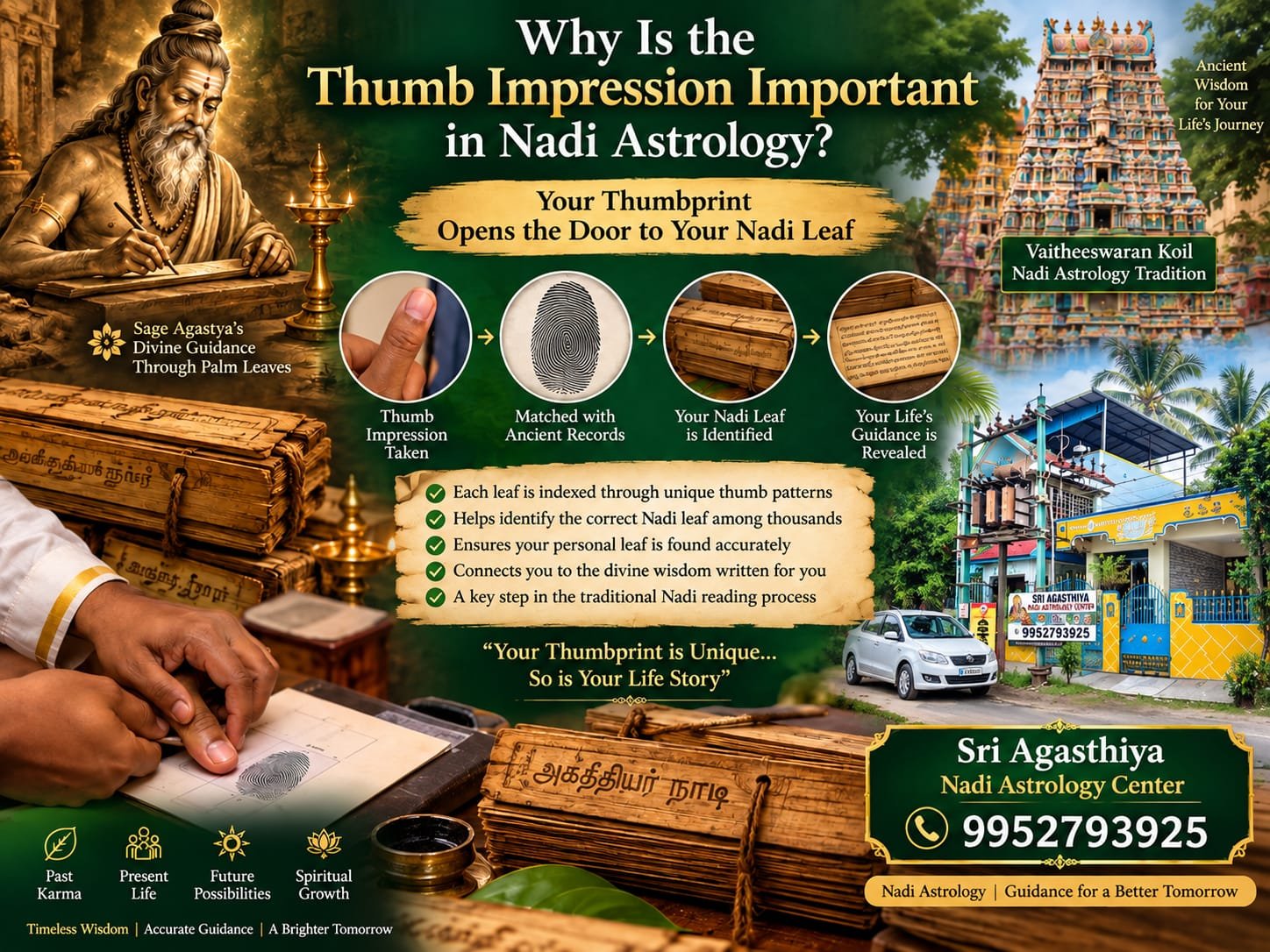
A traditional session commonly begins with the thumb impression of the person seeking the reading. In Nadi practice, thumb impressions are used as a way of placing individuals into particular categories that help the reader begin searching through groups of palm-leaf bundles. The impression itself is not presented as a complete prediction of a person’s future. Instead, within the tradition, it functions more like an initial reference point for selecting which collection of leaves should be examined first. After this starting category has been determined, the Nadi reader may bring out one or more bundles of preserved palm leaves. Each bundle can contain several individual leaves, so finding a possible match is usually a process rather than a single instant selection. This is where patience becomes an important part of the experience.
The reader then begins examining leaves from the selected bundle and traditionally asks a sequence of questions based on information written on them. These questions may concern personal or family details. Instead of immediately asking the visitor to provide a complete life history, the traditional identification method often works through confirmation. The reader presents information or asks questions, and the visitor confirms whether the details correspond to their life. A leaf that does not match is set aside and another is considered. In this way, the search gradually moves from a broad group of manuscripts toward a more specific possible match. Sometimes several leaves may need to be checked before the identification process reaches a conclusion. This is why a Nadi consultation should not be imagined simply as choosing a random palm leaf from a shelf. In the traditional method, the search and confirmation stage is itself an important part of the reading.
When a sequence of details is considered to correspond sufficiently with the visitor, that particular manuscript may be treated within the tradition as the person’s identified Nadi leaf. Only after this stage does the more detailed reading generally begin. Depending on the type of leaf and reading requested, the manuscript may traditionally discuss subjects such as family circumstances, education, career, marriage, finances, responsibilities, personal challenges, spiritual interests, or different stages of life. Some Nadi traditions also organize material into sections commonly known as Kandams, with different sections associated with different areas of life. The exact procedure, terminology, availability of leaves, and style of interpretation can vary between Nadi readers and centers, so not every consultation will follow precisely the same sequence.
The physical palm leaves themselves are also an important part of the atmosphere and heritage surrounding Nadi Astrology. Old manuscripts can carry visible signs of age, including changes in color, texture, and edges. Traditionally, writing was inscribed onto prepared palm leaves and the leaves were preserved together in bundles. Looking at such manuscripts gives a visitor a sense of how knowledge was recorded before modern books, computers, and digital databases became common. The importance of these leaves is therefore not limited to astrology alone; they also represent an old manuscript culture in which information was carefully written, bundled, protected, copied, and passed through generations. Because of their age and fragile nature, preservation and responsible handling are important wherever genuinely old manuscripts are maintained.
Vaitheeswaran Koil in Tamil Nadu has become strongly associated with Nadi Astrology traditions, and many people visiting the area encounter centers offering palm-leaf readings. For visitors, understanding the identification process beforehand can make the consultation less confusing. The thumb impression begins the traditional classification, the relevant bundles are searched, candidate leaves are examined, identifying statements are checked, and a possible matching leaf is selected before its contents are interpreted in greater detail. Seeing the process as these connected stages is more useful than expecting the reader to immediately produce a leaf carrying a person’s name the moment they arrive.
It is also helpful to approach Nadi Astrology with both cultural respect and thoughtful judgment. Nadi Astrology belongs to a long-standing spiritual and astrological tradition, but claims about a manuscript accurately describing an individual’s past or predicting their future should not be confused with scientifically established evidence. A reading can be approached as a traditional, cultural, spiritual, or personal experience without treating every statement as guaranteed fact. Important decisions involving health, education, money, legal matters, or other major life choices are better made using appropriate professional advice and reliable information alongside any personal spiritual beliefs.
At a traditional Nadi consultation, communication between the reader and visitor also matters greatly. A responsible explanation should help the visitor understand what is happening at each stage rather than creating unnecessary fear or pressure. The reader can explain why the thumb impression is being collected, how bundles are selected, why several leaves may be checked, and how the confirmation stage works. This transparency allows the visitor to appreciate the traditional method while making their own decisions about how much meaning they wish to place on the reading.
For people learning about this practice through Guruji Ramesh Swamy, the traditional Nadi leaf identification process can be understood as a journey with several connected stages: beginning with the thumb impression, moving through the selection of palm-leaf bundles, checking information through a question-and-confirmation process, identifying a possible matching manuscript, and finally proceeding to the detailed reading. Each stage has its own place within the tradition. The most interesting part is not simply the final leaf but the method through which the search is carried out. Ancient palm leaves, the memory of Siddhar traditions, the cultural connection with Vaitheeswaran Koil, and the careful process of examining manuscripts together create an experience that feels very different from many modern forms of astrology.
Ultimately, understanding the traditional Nadi leaf identification process means understanding that the reading is presented as more than a prediction session. It is a manuscript-search tradition shaped by old methods of recording knowledge, generations of preservation, spiritual beliefs, and a distinctive system of identification. Whether someone approaches it because of faith, family tradition, historical curiosity, or an interest in Nadi Astrology, knowing how the process works helps them experience it with greater clarity. The thumb impression provides the traditional starting point, the bundles provide the field of search, confirmation helps narrow the possibilities, and the selected palm leaf becomes the focus of the subsequent reading. In that sense, the identification journey itself is what gives a traditional Nadi consultation its unique character—connecting a modern visitor with a practice centered on palm leaves, inherited knowledge, and an enduring part of Tamil cultural tradition.

Understanding the Traditional Nadi Leaf Identification Process

Understanding the Traditional Nadi Leaf Identification Process?

The traditional Nadi leaf identification process is one of the most distinctive parts of Nadi Astrology because the journey does not usually begin by simply opening a palm leaf and reading it. It begins with a careful search intended to identify a manuscript traditionally associated with the individual who has come for a reading. For someone experiencing this tradition for the first time, the process can feel unfamiliar, but when it is explained in simple steps, it becomes much easier to understand. Nadi Astrology is closely connected with ancient palm-leaf manuscripts and traditions associated with sages such as Agastya. These manuscripts are traditionally believed to contain observations and guidance concerning different areas of human life. The identification process is therefore treated as an important stage before the main reading begins. Rather than assuming that every bundle of leaves belongs to every visitor, the reader follows a method of narrowing down the available manuscripts until a possible matching leaf is found.
A traditional session commonly begins with the thumb impression of the person seeking the reading. In Nadi practice, thumb impressions are used as a way of placing individuals into particular categories that help the reader begin searching through groups of palm-leaf bundles. The impression itself is not presented as a complete prediction of a person’s future. Instead, within the tradition, it functions more like an initial reference point for selecting which collection of leaves should be examined first. After this starting category has been determined, the Nadi reader may bring out one or more bundles of preserved palm leaves. Each bundle can contain several individual leaves, so finding a possible match is usually a process rather than a single instant selection. This is where patience becomes an important part of the experience.
The reader then begins examining leaves from the selected bundle and traditionally asks a sequence of questions based on information written on them. These questions may concern personal or family details. Instead of immediately asking the visitor to provide a complete life history, the traditional identification method often works through confirmation. The reader presents information or asks questions, and the visitor confirms whether the details correspond to their life. A leaf that does not match is set aside and another is considered. In this way, the search gradually moves from a broad group of manuscripts toward a more specific possible match. Sometimes several leaves may need to be checked before the identification process reaches a conclusion. This is why a Nadi consultation should not be imagined simply as choosing a random palm leaf from a shelf. In the traditional method, the search and confirmation stage is itself an important part of the reading.
When a sequence of details is considered to correspond sufficiently with the visitor, that particular manuscript may be treated within the tradition as the person’s identified Nadi leaf. Only after this stage does the more detailed reading generally begin. Depending on the type of leaf and reading requested, the manuscript may traditionally discuss subjects such as family circumstances, education, career, marriage, finances, responsibilities, personal challenges, spiritual interests, or different stages of life. Some Nadi traditions also organize material into sections commonly known as Kandams, with different sections associated with different areas of life. The exact procedure, terminology, availability of leaves, and style of interpretation can vary between Nadi readers and centers, so not every consultation will follow precisely the same sequence.
The physical palm leaves themselves are also an important part of the atmosphere and heritage surrounding Nadi Astrology. Old manuscripts can carry visible signs of age, including changes in color, texture, and edges. Traditionally, writing was inscribed onto prepared palm leaves and the leaves were preserved together in bundles. Looking at such manuscripts gives a visitor a sense of how knowledge was recorded before modern books, computers, and digital databases became common. The importance of these leaves is therefore not limited to astrology alone; they also represent an old manuscript culture in which information was carefully written, bundled, protected, copied, and passed through generations. Because of their age and fragile nature, preservation and responsible handling are important wherever genuinely old manuscripts are maintained.
Vaitheeswaran Koil in Tamil Nadu has become strongly associated with Nadi Astrology traditions, and many people visiting the area encounter centers offering palm-leaf readings. For visitors, understanding the identification process beforehand can make the consultation less confusing. The thumb impression begins the traditional classification, the relevant bundles are searched, candidate leaves are examined, identifying statements are checked, and a possible matching leaf is selected before its contents are interpreted in greater detail. Seeing the process as these connected stages is more useful than expecting the reader to immediately produce a leaf carrying a person’s name the moment they arrive.
It is also helpful to approach Nadi Astrology with both cultural respect and thoughtful judgment. Nadi Astrology belongs to a long-standing spiritual and astrological tradition, but claims about a manuscript accurately describing an individual’s past or predicting their future should not be confused with scientifically established evidence. A reading can be approached as a traditional, cultural, spiritual, or personal experience without treating every statement as guaranteed fact. Important decisions involving health, education, money, legal matters, or other major life choices are better made using appropriate professional advice and reliable information alongside any personal spiritual beliefs.
At a traditional Nadi consultation, communication between the reader and visitor also matters greatly. A responsible explanation should help the visitor understand what is happening at each stage rather than creating unnecessary fear or pressure. The reader can explain why the thumb impression is being collected, how bundles are selected, why several leaves may be checked, and how the confirmation stage works. This transparency allows the visitor to appreciate the traditional method while making their own decisions about how much meaning they wish to place on the reading.
For people learning about this practice through Guruji Ramesh Swamy, the traditional Nadi leaf identification process can be understood as a journey with several connected stages: beginning with the thumb impression, moving through the selection of palm-leaf bundles, checking information through a question-and-confirmation process, identifying a possible matching manuscript, and finally proceeding to the detailed reading. Each stage has its own place within the tradition. The most interesting part is not simply the final leaf but the method through which the search is carried out. Ancient palm leaves, the memory of Siddhar traditions, the cultural connection with Vaitheeswaran Koil, and the careful process of examining manuscripts together create an experience that feels very different from many modern forms of astrology.
Ultimately, understanding the traditional Nadi leaf identification process means understanding that the reading is presented as more than a prediction session. It is a manuscript-search tradition shaped by old methods of recording knowledge, generations of preservation, spiritual beliefs, and a distinctive system of identification. Whether someone approaches it because of faith, family tradition, historical curiosity, or an interest in Nadi Astrology, knowing how the process works helps them experience it with greater clarity. The thumb impression provides the traditional starting point, the bundles provide the field of search, confirmation helps narrow the possibilities, and the selected palm leaf becomes the focus of the subsequent reading. In that sense, the identification journey itself is what gives a traditional Nadi consultation its unique character—connecting a modern visitor with a practice centered on palm leaves, inherited knowledge, and an enduring part of Tamil cultural tradition.

Vaitheeswaran Koil Nadi Expert – Trusted Nadi Astrologer

Vaitheeswaran Koil Nadi Expert – Trusted Nadi Astrologer

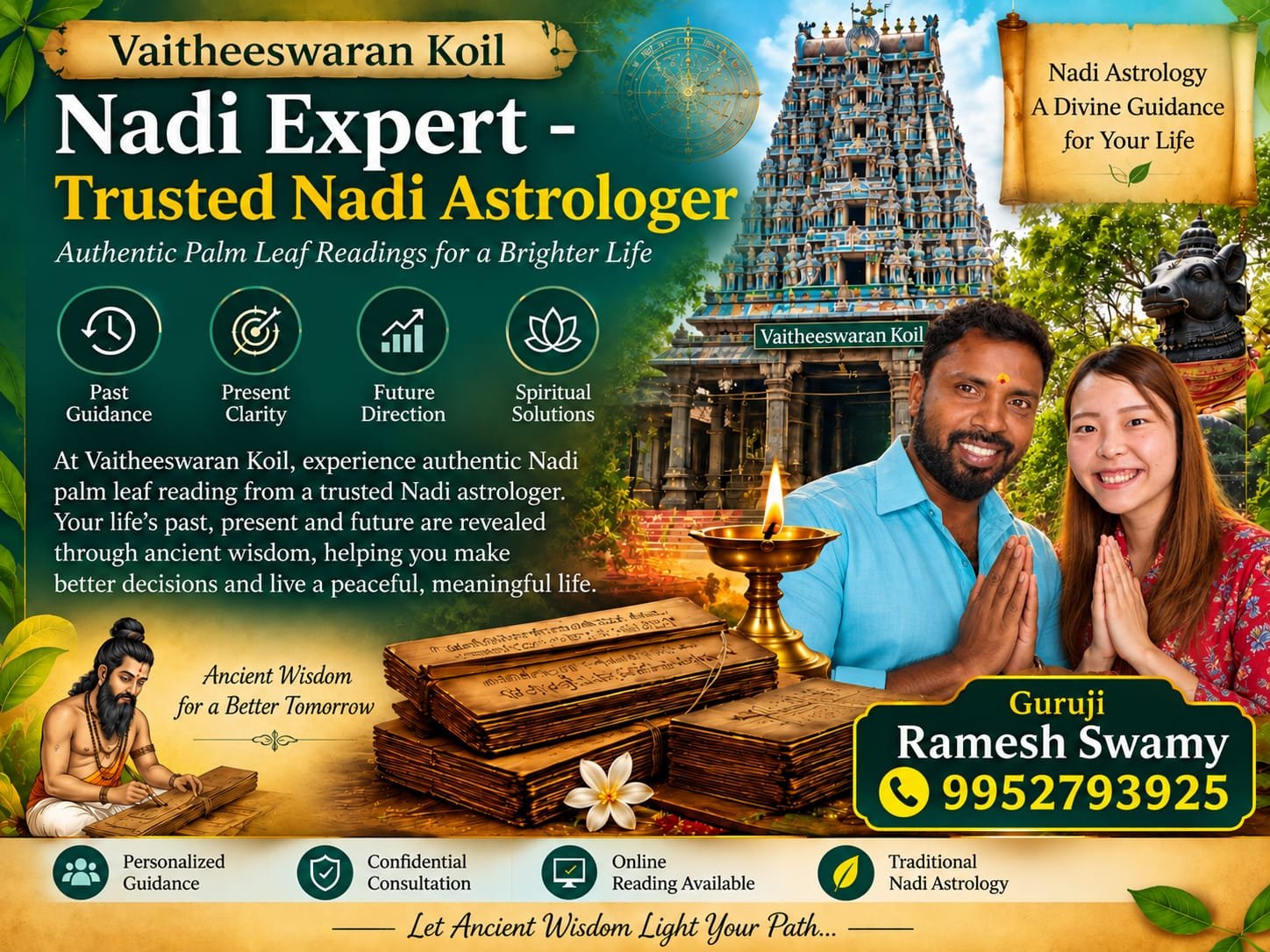
Vaitheeswaran Koil has long been associated with the traditional practice of Nadi Astrology, an ancient system connected with palm-leaf manuscripts and the wisdom passed down through generations. For many people, a Nadi Astrology consultation is not simply about hearing predictions; it is an opportunity to explore life from a traditional spiritual perspective and understand different stages of one’s personal journey. The palm-leaf tradition is often associated with ancient Siddhars, including Sage Agastya, whose name holds an important place in the Nadi tradition. People visiting Vaitheeswaran Koil may seek Nadi readings to learn about subjects such as family, education, career, marriage, finances, relationships, personal responsibilities, spiritual interests, and future plans. A trusted Nadi astrologer helps explain the traditional reading carefully so that visitors can understand the information in a simple and comfortable manner.

One of the distinctive features associated with traditional Nadi Astrology is the process of searching for a corresponding palm-leaf manuscript. The consultation may begin with basic identification procedures used within the Nadi tradition. A thumb impression is commonly used as part of the classification process before suitable bundles of palm leaves are examined. The reader may then use a sequence of questions and answers to narrow down the search. Rather than immediately assuming that a particular leaf belongs to a visitor, the traditional process involves checking identifying details until a suitable match is considered to have been found. This search itself can be an interesting experience for people who are learning about Nadi Astrology for the first time.

After a palm leaf is identified, the information associated with the reading is explained in an understandable way. Traditional readings can cover different areas of life depending on the type of consultation and the material being interpreted. Some visitors are mainly interested in their career direction, while others may want to discuss marriage, family responsibilities, business, education, financial planning, or personal development. The value of a consultation for many visitors comes from having the traditional material explained patiently rather than receiving complicated terminology without context. A clear conversation gives the person an opportunity to ask questions and better understand what the reader is describing.

At Sri Agasthiya Nadi Astrology Center, the focus can be presented around preserving this traditional approach while making the consultation easier for modern visitors to follow. Guruji Ramesh Swamy can guide visitors through the Nadi reading process by explaining each stage in straightforward language. Someone who has never experienced palm-leaf astrology before may naturally have questions about how leaves are classified, how a particular manuscript is searched for, what information may be discussed, and how the reading proceeds. Providing these explanations clearly can help visitors understand the tradition rather than treating the consultation as a rushed experience.

Vaitheeswaran Koil also gives Nadi Astrology a distinctive cultural setting. The town is widely associated with temple traditions, devotional practices, and generations of palm-leaf astrology readers. For visitors interested in traditional Indian astrology, experiencing a Nadi consultation in this setting can provide additional historical and cultural context. Palm-leaf bundles, traditional reading methods, Tamil verses or writings, and the interpretation process together create an experience that differs from a standard horoscope consultation. Instead of beginning only with a modern printed birth chart, Nadi Astrology is traditionally centered on identifying and interpreting preserved palm-leaf records.

Another important part of a good consultation is communication. Ancient traditions can sometimes appear difficult to understand when they are presented using unfamiliar terminology. A reader who explains the meaning patiently can make the experience more accessible. Visitors should feel comfortable asking what a particular statement means, which part of life is being discussed, and how the traditional interpretation is understood. This creates a more informative experience and allows the person receiving the reading to consider the information thoughtfully rather than accepting every statement without question.

Modern technology has also made it possible for people who cannot easily travel to Vaitheeswaran Koil to enquire about online Nadi Astrology consultations. People living elsewhere in India or abroad may want to understand how the identification process works remotely and what information is required before arranging a consultation. Online communication can make initial enquiries, appointment coordination, and explanations more convenient. At the same time, clearly explaining the traditional process remains important so that visitors understand what they are requesting before proceeding with a reading.

A responsible approach to Nadi Astrology should also respect personal choice. Astrology can provide a traditional or spiritual perspective, but important decisions involving health, education, money, legal matters, relationships, or career should still be considered carefully using appropriate practical information and professional advice where necessary. A Nadi reading can therefore be approached as a traditional form of guidance and reflection rather than as a replacement for a person’s own judgment. This balanced understanding can make the consultation more meaningful and help visitors engage with the tradition thoughtfully.

For people searching for a Vaitheeswaran Koil Nadi Expert or Trusted Nadi Astrologer, it can be useful to look for a consultation where the procedure, available services, fees, and expectations are communicated clearly. Visitors may also ask beforehand whether the consultation is conducted directly or online, how long the process may take, and what information they should have ready. Transparent communication can make the experience smoother, particularly for first-time visitors who may not be familiar with the Nadi palm-leaf tradition.

Ultimately, Nadi Astrology in Vaitheeswaran Koil represents a meeting point between ancient palm-leaf tradition and the questions people continue to ask about their lives today. The manuscripts, Siddhar tradition, identification process, interpretation, and personal conversation all contribute to its distinctive character. Under the guidance of Guruji Ramesh Swamy, visitors to Sri Agasthiya Nadi Astrology Center can explore this traditional system in a clear and approachable way. Whether someone visits Vaitheeswaran Koil personally or enquires about an online consultation, the experience can serve as an opportunity to discover the history and methods of Nadi Astrology while reflecting thoughtfully on family, career, relationships, responsibilities, personal goals, and the path ahead.