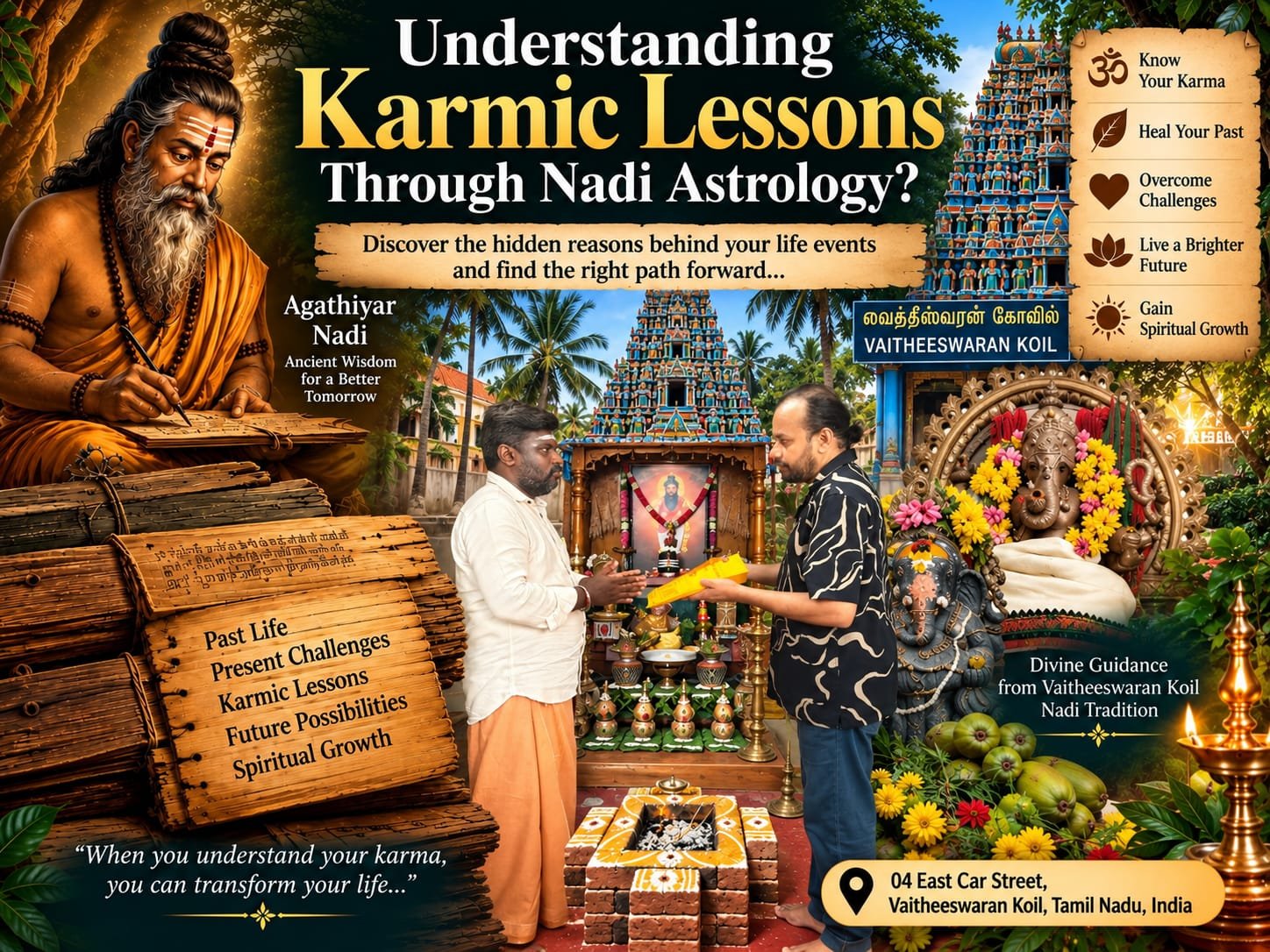
Life is often experienced as a journey filled with happiness, responsibility, relationships, unexpected changes, achievements, disappointments, and questions that do not always have immediate answers. At certain stages, a person may wonder why similar situations keep returning, why some goals are reached easily while others seem to face repeated obstacles, or why particular people and experiences enter life at significant moments. In the traditional understanding of Nadi Astrology, these experiences may be viewed through the spiritual idea of karma—a belief that actions, intentions, choices, and their consequences are connected across the journey of the soul. Nadi Astrology, especially the Agathiyar Nadi tradition associated with ancient palm-leaf manuscripts, approaches karma not simply as reward or punishment but as a way of reflecting on life’s patterns, responsibilities, and opportunities for personal growth. According to this tradition, a Nadi reading may discuss different areas of life such as family, education, profession, marriage, finance, health, spiritual interests, challenges, and future possibilities. For believers, the purpose of learning about karmic lessons is not to create fear about the past, but to encourage greater awareness about the present. A difficult experience can sometimes become an opportunity to develop patience, discipline, understanding, forgiveness, or better decision-making. In the same way, positive circumstances may remind a person to use their opportunities responsibly and to share kindness with others. This perspective gives the word “karma” a deeper meaning: instead of thinking that everything is permanently fixed, it encourages people to examine how their present actions can influence the direction of their lives. The ancient palm-leaf tradition is often described as a bridge between spiritual wisdom and individual self-reflection. During a traditional Nadi consultation, a suitable palm leaf is sought through an identification process, commonly associated with the thumb impression and a sequence of confirmation questions. Once a matching leaf is believed to have been identified, its contents are traditionally interpreted by the Nadi reader. The reading may contain references to personal circumstances and may also present spiritual guidance according to the customs of that particular Nadi tradition. Such guidance should be understood within its religious and cultural context rather than as scientifically established prediction. One of the most meaningful ideas behind karmic reflection is that understanding the past can be valuable when it helps a person live the present more thoughtfully. People sometimes carry anger, regret, confusion, or disappointment because they cannot understand why certain events happened. A spiritual interpretation may offer them another framework through which to reflect on those experiences. Rather than remaining focused only on “Why did this happen to me?”, a person may begin asking, “What can I learn from this experience?” or “What can I do differently from today?” That change in perspective can itself become an important lesson. Nadi traditions may also discuss the importance of relationships in karmic learning. Parents, children, spouses, relatives, friends, teachers, and colleagues can all influence a person’s emotional and practical development. Some relationships bring support and happiness, while others require patience and careful communication. Looking at these experiences through a karmic lens can encourage a person to think about responsibility, compassion, boundaries, gratitude, and forgiveness without assuming that every difficulty has a single supernatural explanation. Career and financial experiences can also be considered from this reflective viewpoint. Success may require not only opportunity but consistent effort, skill development, ethical choices, and patience. Delays or setbacks can sometimes encourage a person to reconsider priorities and improve preparation. In this sense, a karmic lesson can be understood as an invitation to become more conscious of one’s choices rather than simply waiting for destiny to change. Spiritual traditions surrounding Nadi Astrology also emphasize practices such as prayer, charity, respect for elders, helping people in need, visiting sacred places, and living with greater discipline. Different Nadi traditions may recommend different forms of pariharam or remedial worship. These practices belong to a faith tradition, so their meaning depends greatly on an individual’s beliefs. They should not replace qualified medical, legal, financial, or other professional advice when such help is needed. Vaitheeswaran Koil in Tamil Nadu has a particularly strong cultural association with the Nadi palm-leaf tradition, and visitors interested in this heritage often connect the place with generations of Nadi readers and preserved manuscripts. The atmosphere of temples, traditional rituals, palm leaves, and stories connected with Siddhars contributes to the spiritual identity of the tradition. Yet the deeper message behind “Understanding Karmic Lessons Through Nadi Astrology” can be expressed simply: whatever interpretation a person receives, the most useful outcome is thoughtful reflection followed by responsible action. Knowledge becomes meaningful when it encourages someone to communicate better, correct avoidable mistakes, appreciate supportive relationships, work sincerely toward goals, and approach difficulties with greater patience. A Nadi reading should therefore not be treated as a reason to surrender personal responsibility. Instead, within the tradition, it can be approached as spiritual guidance that invites a person to examine the relationship between yesterday’s experiences, today’s choices, and tomorrow’s possibilities. Every individual has a different story, and no single explanation can capture every part of human life. The value people find in Nadi Astrology may come from its combination of ancient tradition, spiritual symbolism, family heritage, and personal introspection. For those who wish to explore this traditional approach to karmic lessons and Agathiyar Nadi Astrology, Guruji Ramesh Swamy – 9952793925 can be mentioned as the contact for further information about a Nadi consultation. Ultimately, understanding karma is not merely about searching for events from a previous life or trying to know everything that will happen in the future. It can also be about recognizing the power of today’s thoughts, actions, relationships, and decisions. The past may offer lessons, tradition may offer a framework, and spiritual practices may offer comfort, but each person still has choices to make in the present. When approached with that balanced understanding, Nadi Astrology can serve as a traditional spiritual lens for reflecting on life’s recurring patterns and asking a valuable question: What lesson can I understand today that may help me create a wiser tomorrow?