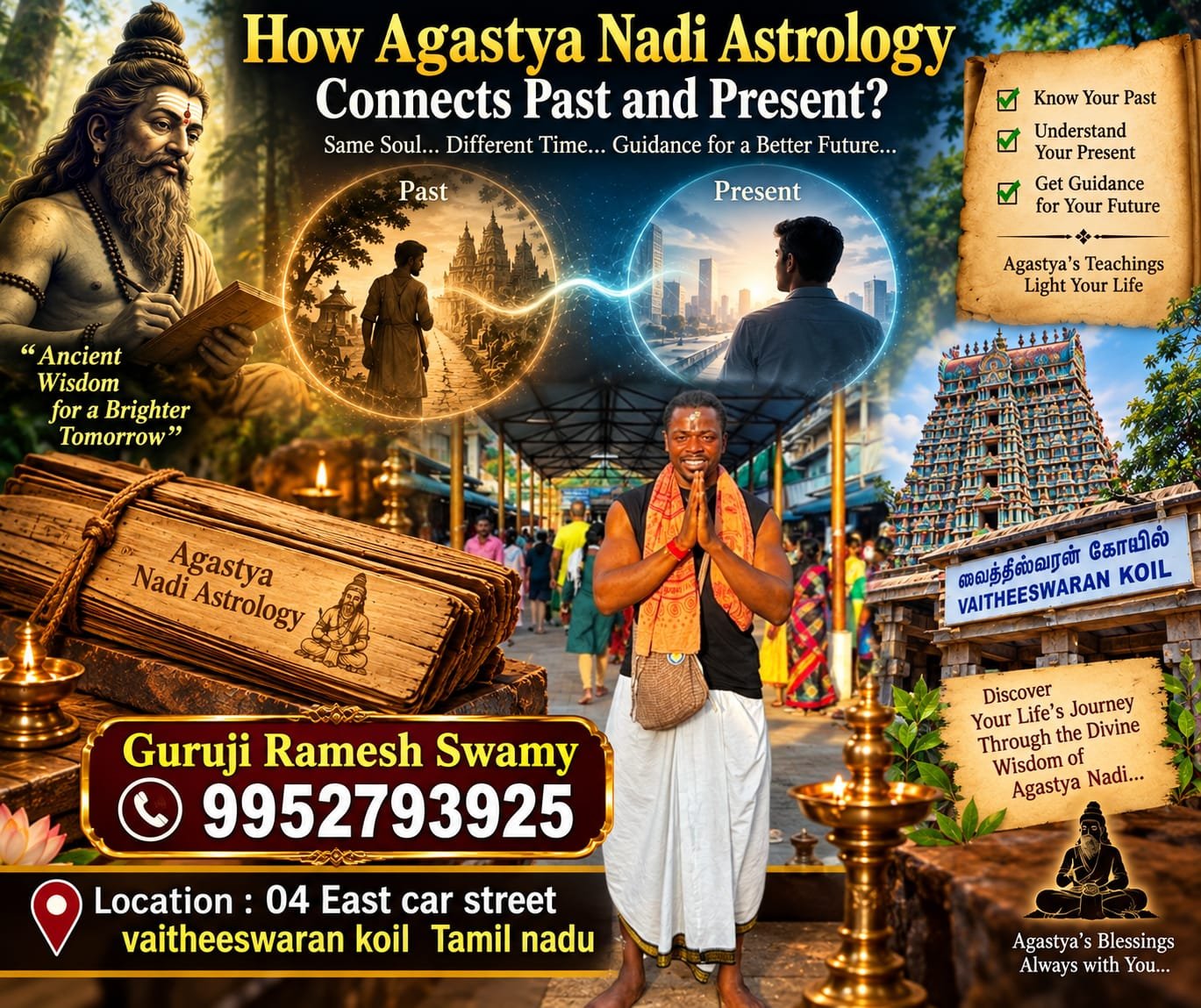
How Agastya Nadi Astrology Connects Past and Present?

How Agastya Nadi Astrology Connects Past and Present?

Agastya Nadi Astrology is an ancient spiritual tradition that presents human life as a continuing journey in which the experiences of the past, the circumstances of the present, and the possibilities of the future are understood as interconnected. According to the traditional belief surrounding Nadi Astrology, the wisdom attributed to Sage Agastya was preserved through palm-leaf manuscripts so that seekers in later generations could receive guidance about important areas of their lives. The idea of connecting past and present does not simply mean looking backward at events that have already happened; rather, it encourages a person to reflect on how earlier choices, responsibilities, relationships, habits, and karmic influences may relate to the situations they experience today. In a traditional Nadi consultation, the process often begins with identifying the appropriate palm leaf associated with the seeker, after which the contents are interpreted and explained in relation to the person’s life. This creates a symbolic bridge between ancient knowledge and modern-day questions. Someone living in today’s fast-moving world may have concerns about family, education, career, marriage, finances, personal responsibilities, or the direction of life, while the Nadi tradition approaches these concerns through an older spiritual understanding of karma, destiny, and individual experience. The concept of karma plays an important role in explaining this connection. In this tradition, karma is commonly understood as the relationship between actions and their consequences across the broader journey of life. Past influences are therefore considered not merely as memories but as part of a continuing pattern that may help a seeker reflect on present circumstances. At the same time, Nadi Astrology should not be understood as removing personal choice or responsibility. A reading can be approached as traditional spiritual guidance and a source of reflection, while important decisions in areas such as health, education, finance, career, or relationships should still be made using appropriate practical information and professional advice when needed. One of the distinctive features associated with Agastya Nadi Astrology is the use of ancient palm-leaf manuscripts. These leaves represent a tradition preserved across generations, and their physical appearance itself creates a connection with history. The handwritten or inscribed leaves, traditional methods of classification, and the process of identifying a corresponding manuscript give the consultation a character very different from modern digital forms of astrology. When a seeker listens to a Nadi reading today, an ancient manuscript is being interpreted within the context of a contemporary life. In that sense, the past and present meet in a single conversation: ancient spiritual ideas are considered alongside today’s personal questions. Vaitheeswaran Koil in Tamil Nadu has long been associated with traditions of Nadi Astrology, and visitors interested in this practice often connect the place with palm-leaf readings and the heritage surrounding them. Within this traditional setting, a consultation may encourage seekers to examine where they have come from, understand the responsibilities they currently face, and think carefully about the direction in which they want to move. The value that many people seek from such an experience is not merely a list of future predictions. They may also be looking for a meaningful framework through which to understand recurring experiences, family responsibilities, personal strengths, difficult periods, opportunities, and major transitions. When past experiences are considered thoughtfully, they can sometimes help people recognize patterns that were previously overlooked. When the present is examined with greater awareness, people may become more deliberate about the choices they make next. This is one reason the theme “How Agastya Nadi Astrology Connects Past and Present” carries a deeper meaning: it represents a conversation between inherited wisdom and present-day life. Ancient teachings provide the traditional framework, while the seeker brings current experiences, questions, and decisions into that framework. The reading therefore becomes an encounter between two different periods of time rather than simply an attempt to predict what will happen next. Guruji L Ramesh Swamy – 9952793925 offers Agastya Nadi Astrology consultations for people who wish to explore this traditional palm-leaf practice and understand its spiritual interpretation of karma, past influences, present circumstances, and future direction. During a consultation, explanations can help the seeker understand the traditional meaning of the information being presented rather than treating the palm-leaf statements as isolated sentences. This personal explanation is particularly important because every individual’s circumstances are different, and traditional concepts often need to be understood within the person’s own life context. For someone approaching Nadi Astrology for the first time, the experience can also provide an introduction to the cultural heritage connected with palm-leaf manuscripts, Sage Agastya, and Vaitheeswaran Koil. The manuscripts symbolize knowledge carried forward from earlier generations, while the person receiving the reading represents the present generation searching for understanding. Between them stands the interpretive tradition that keeps the practice alive. The past may offer stories, teachings, and symbolic explanations; the present provides the opportunity to reflect on them and decide what meaning they hold today. The future, meanwhile, remains something that individuals continue to shape through their decisions, circumstances, effort, and responsibilities. Seen from this perspective, Agastya Nadi Astrology is not only about asking, “What will happen to me?” It can also encourage questions such as, “What can I understand about my present life?”, “What patterns should I pay attention to?”, and “How can traditional wisdom help me reflect more carefully on the path ahead?” These questions demonstrate how an ancient practice can continue to hold cultural and spiritual significance in modern times. For seekers interested in experiencing this tradition and learning more about the palm-leaf reading process, Guruji L Ramesh Swamy – 9952793925 can be contacted for information about an Agastya Nadi Astrology consultation. Through the meeting of ancient palm-leaf heritage and present-day personal reflection, the tradition continues to express its central idea: the past can provide a perspective for understanding the present, while the choices made in the present become part of the journey toward the future.
12

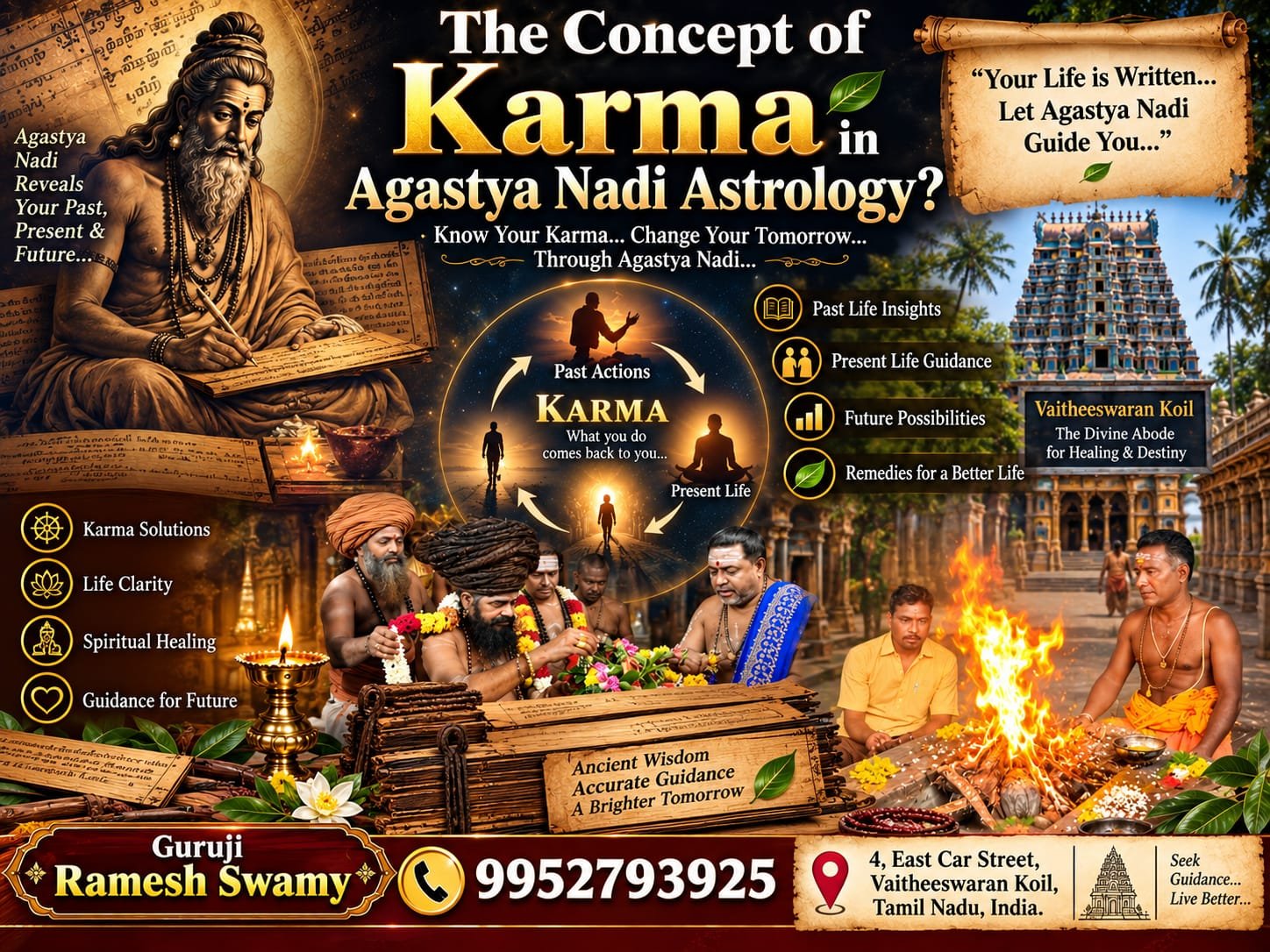
The Concept of Karma in Agastya Nadi Astrology ?

The concept of karma in Agastya Nadi Astrology can be understood as a spiritual way of looking at how a person’s actions, choices, intentions, responsibilities, and experiences may be connected across different stages of life. In the traditional understanding of Nadi Astrology, life is not always viewed as a collection of unrelated events. Instead, every experience may be considered part of a larger journey in which past actions influence present circumstances, while present choices help shape the direction of the future. Agastya Nadi Astrology is traditionally associated with ancient palm-leaf manuscripts and the wisdom attributed to Sage Agastya. Within this tradition, karma is often discussed not simply as punishment or reward, but as a principle of cause, consequence, learning, responsibility, and personal transformation. This distinction is important because karma does not necessarily mean that every difficulty in life should be viewed negatively. A challenging period may be interpreted as an opportunity to understand oneself more deeply, correct an unhealthy pattern, develop patience, fulfil an overlooked responsibility, or approach life with greater awareness. Similarly, a favourable period may be regarded as an opportunity to use one’s circumstances wisely rather than taking them for granted. The Nadi tradition commonly approaches human life through different areas such as family, education, career, marriage, finances, relationships, health, spiritual interests, and personal responsibilities. During a traditional reading, these areas may be discussed in relation to the individual’s life journey and the karmic themes described in the reading. The central idea is that the present moment stands between what has already happened and what has yet to unfold. What has happened cannot always be changed, but the way a person responds today can influence tomorrow. This gives the concept of karma a practical meaning: awareness can lead to better choices. For example, when someone repeatedly encounters similar conflicts, delays, misunderstandings, or emotional difficulties, a karmic interpretation may encourage that person to examine recurring habits and reactions rather than simply blaming circumstances. In this sense, karma becomes a mirror for reflection. It encourages questions such as: What can I learn from this experience? Is there a pattern that needs to change? Am I treating others fairly? Am I fulfilling my responsibilities? Are my current decisions taking me toward the kind of life I want to build? These questions can turn a spiritual concept into an opportunity for thoughtful self-examination.

In Agastya Nadi Astrology, the ideas of past, present, and future are often described as interconnected rather than completely separate. Traditional belief holds that some circumstances experienced in the present may have roots in earlier karmic actions. However, this does not have to be understood as saying that a person has no freedom. A more balanced interpretation is that circumstances may create a starting point, while present decisions determine how a person responds to that starting point. Two people may face similar difficulties but react in completely different ways. One may respond with anger and repeat the same pattern, while another may respond with patience, understanding, and careful action. Their future experiences can therefore develop differently. This is why personal responsibility occupies an important place in discussions about karma. Nadi guidance may encourage individuals to become conscious of their behaviour instead of becoming fearful about destiny. Traditional remedial practices may also be mentioned in some readings. Depending on the tradition and interpretation, these can include prayer, charitable acts, helping people in need, showing respect to parents and elders, visiting sacred places, practising gratitude, or performing particular devotional observances. Such practices are traditionally understood as ways of encouraging discipline, humility, compassion, and spiritual reflection; they should not be treated as guaranteed solutions to medical, financial, legal, or other practical problems. One of the meaningful aspects of the karmic philosophy is that positive action does not need to begin with something extraordinary. Speaking kindly, keeping promises, helping another person without expecting a reward, correcting a mistake, avoiding unnecessary harm, respecting family responsibilities, and acting honestly can all be viewed as constructive actions. Small decisions repeated consistently can gradually influence a person’s character and relationships. From this perspective, karma is not merely about discovering what happened in a supposed previous birth; it is equally concerned with how someone chooses to live now.

A traditional Nadi consultation may therefore be approached as an opportunity for reflection rather than as a reason to become anxious about the future. Guruji Ramesh Swamy – 9952793925 offers guidance connected with the Agastya Nadi Astrology tradition and palm-leaf reading. Those interested in this tradition may use a consultation to explore the spiritual interpretation of their life journey, recurring patterns, responsibilities, and possible future directions. At the same time, major decisions involving health, education, finances, marriage, career, or legal matters are best made using reliable practical information and appropriate professional advice alongside any spiritual guidance. The deeper message associated with karma is not that life is permanently fixed by the past. Rather, it invites a person to understand the past, become more conscious in the present, and approach the future with responsibility. Yesterday may provide the background, but today still contains choices. When those choices are guided by patience, honesty, compassion, discipline, and thoughtful action, the individual can develop a different relationship with both difficulties and opportunities. In this way, the concept of karma in Agastya Nadi Astrology becomes more than a prediction about destiny. It becomes a philosophy of awareness: understand the patterns behind your experiences, learn what those experiences can teach you, fulfil your responsibilities with sincerity, and use the present moment wisely. The palm leaf, in the traditional spiritual view, may describe a path, but the person walking that path still has decisions to make. Karma can therefore be seen not simply as something carried from the past, but also as something being created through every meaningful action in the present.

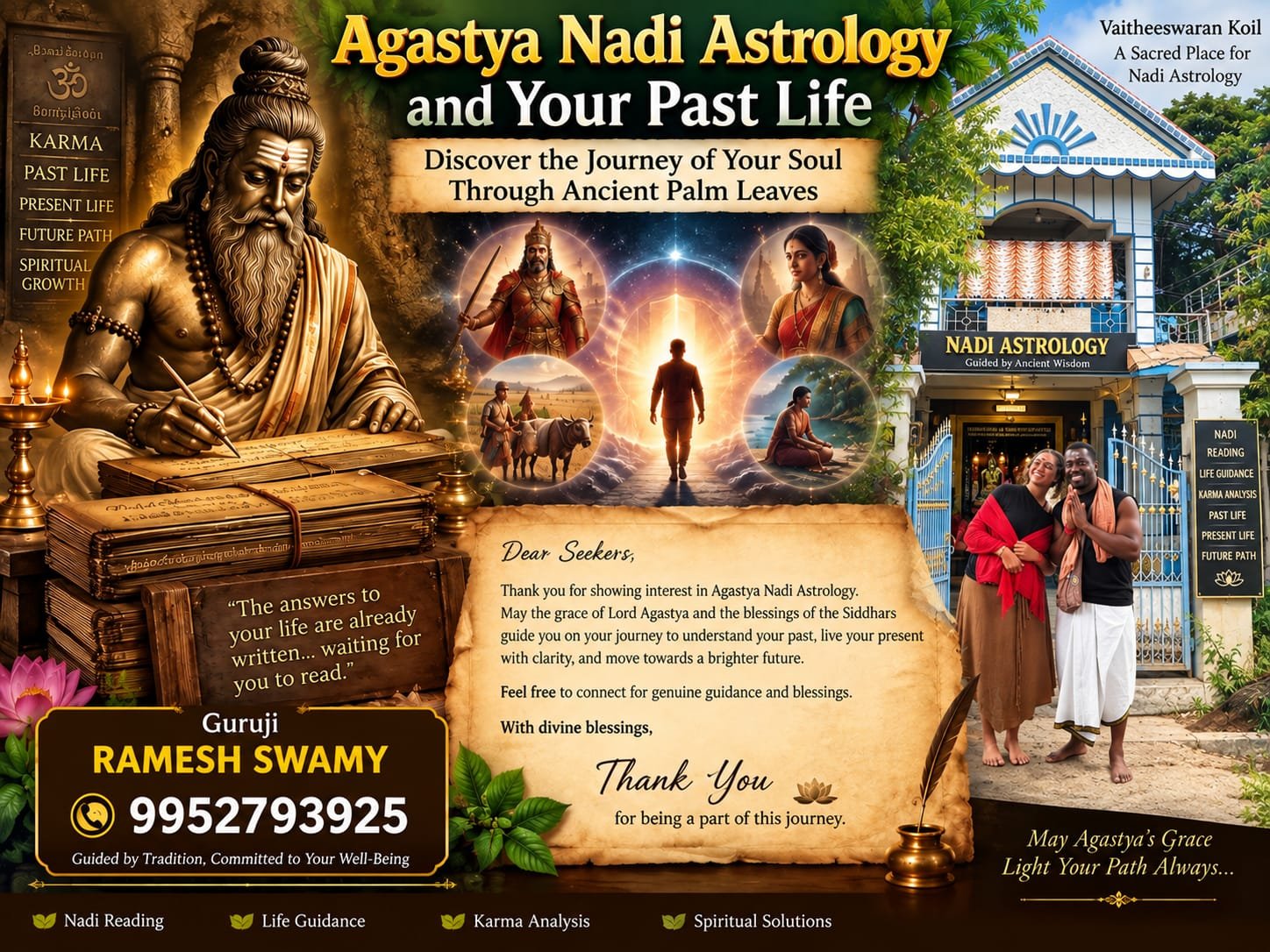
Agastya Nadi Astrology and Your Past Life ?

Agastya Nadi Astrology and Your Past Life ?

Agastya Nadi Astrology is an ancient spiritual tradition associated with palm-leaf manuscripts and the wisdom attributed to Sage Agastya. For many people, the most fascinating part of this tradition is its connection with the idea of past lives, karma, present circumstances, and the spiritual journey of an individual. According to traditional Nadi beliefs, human life is not viewed simply as a collection of unrelated events. Instead, every experience may be understood as part of a continuing journey shaped by actions, choices, responsibilities, relationships, and lessons. Past-life interpretations in Nadi Astrology are therefore approached as a spiritual framework for reflecting on why certain patterns may appear repeatedly in a person’s present life. These ideas belong to a traditional belief system rather than something established by modern scientific evidence, but they continue to hold cultural and spiritual importance for many people who visit Nadi centers seeking personal reflection and guidance.

In the Agastya Nadi tradition, palm-leaf manuscripts are believed to contain information connected with individuals who will eventually come in search of them. Traditionally, the process begins with identifying a suitable group of palm leaves, often using a thumb impression as part of the classification method. The reader then asks a series of identifying questions while examining different leaves until, according to the tradition, a matching leaf is found. Once a leaf is identified, its contents may be interpreted with reference to different areas of life. These can include family background, education, career, marriage, finances, health, spiritual interests, challenges, and future periods. Some readings may also contain a section traditionally associated with previous births and karmic influences. Rather than treating such a section as a literal historical record that can be independently verified, it can be understood as part of the spiritual worldview in which Nadi Astrology developed.

The concept of karma is central to discussions about past lives in this tradition. Karma is often described as the relationship between actions and their consequences. Within traditional interpretations, a person’s present circumstances may sometimes be connected symbolically or spiritually with actions believed to have occurred in an earlier existence. This does not necessarily mean that every difficulty is described as a punishment. A broader interpretation sees karma as a process through which people encounter experiences, learn lessons, develop qualities, and make new choices. From this perspective, learning about a supposed past-life connection is not meant simply to create curiosity about who someone might have been centuries ago. The greater purpose is to encourage reflection on the present: What patterns are continuing? Which relationships need greater understanding? What responsibilities have been neglected? What habits could be changed? What positive actions can be strengthened? These questions can make the concept of past life meaningful even for someone who approaches the tradition primarily from a cultural or philosophical perspective.

A past-life Nadi interpretation may contain stories or symbolic explanations concerning relationships, responsibilities, unfinished duties, or actions believed to influence present circumstances. For example, traditional interpretations may connect recurring relationship difficulties with unresolved karmic themes, or describe certain opportunities as connected with positive actions from another birth. Such explanations should be understood as religious or spiritual interpretations, not proven diagnoses of why events happen. Real-life circumstances can have many practical causes, including personal decisions, family situations, social conditions, education, finances, and chance. Nadi Astrology offers a different lens: one based on traditional ideas about karma and continuity between lives. People who value the tradition may use that lens alongside practical thinking rather than allowing it to replace careful decision-making.

One particularly meaningful aspect of Agastya Nadi Astrology is its emphasis on the present moment. Although the phrase “past life” naturally directs attention toward the past, traditional spiritual teachings often place greater importance on what a person chooses to do now. Whatever someone believes about previous births, the present is where actions can actually be changed. Patience can replace anger, responsibility can replace neglect, generosity can replace selfishness, and thoughtful decisions can replace repeated mistakes. In this sense, the value of a Nadi reading may lie less in discovering an extraordinary story about an earlier identity and more in encouraging a person to examine current behavior with greater awareness.

Vaitheeswaran Koil in Tamil Nadu is especially associated with the Nadi Astrology tradition and with collections of palm-leaf manuscripts maintained by different families and practitioners. Visitors interested in the tradition often encounter bundles of carefully preserved palm leaves containing writing in older forms of Tamil script. The physical presence of these manuscripts gives the experience a strong connection with history and heritage. Sitting with a traditional reader while a leaf is examined can therefore feel very different from reading a general horoscope online. The experience combines manuscript tradition, oral interpretation, spiritual belief, family knowledge, and the atmosphere of a temple town that has long been connected with Nadi practices.

Another important idea is that past-life information should not create fear. Claims about karma can easily become emotionally powerful, especially when they concern family problems, illness, relationships, or uncertain futures. A responsible approach avoids treating every hardship as evidence of wrongdoing in a supposed previous birth. It also avoids presenting spiritual interpretations as unavoidable destiny. Even within a karmic worldview, present actions matter. A reading can instead become an opportunity to think about forgiveness, gratitude, discipline, compassion, and responsibility. These qualities have practical value regardless of whether a person accepts every metaphysical claim surrounding reincarnation.

Traditional Nadi readings may also mention pariharam, or remedial spiritual practices. Depending on the tradition and interpretation, these may involve prayer, temple worship, charity, feeding people in need, or other devotional activities. Such practices are generally understood within a religious framework and should not be confused with guaranteed solutions to medical, financial, legal, or other serious problems. When practical problems require professional assistance, spiritual practices can exist alongside appropriate real-world support rather than replacing it.

The mystery surrounding palm leaves is one reason Agastya Nadi Astrology continues to attract interest. People naturally wonder how an old manuscript could appear to describe elements of a person’s life. Believers may understand this through the spiritual insight attributed to ancient Siddhars, while skeptics may offer different explanations for how matching and interpretation work. These viewpoints do not have to prevent someone from appreciating the tradition’s historical, cultural, or philosophical dimensions. Approaching a reading thoughtfully means distinguishing between traditional belief, personal interpretation, and independently verifiable fact.

Ultimately, Agastya Nadi Astrology and Your Past Life is not only a topic about discovering an earlier birth. Within the tradition, it represents a larger exploration of karma, personal responsibility, relationships, spiritual growth, and the connection people perceive between their past and present. The palm leaf becomes a symbol of that search for meaning. Whether a person approaches Nadi Astrology with deep spiritual faith, cultural curiosity, or simple interest in an ancient tradition, its past-life teachings invite reflection on an enduring question: not merely “Who was I before?” but “How should I live the life I have now?” That shift from curiosity about yesterday toward awareness of today is perhaps one of the most constructive ways to understand the past-life dimension of the Agastya Nadi tradition.