The traditional Nadi leaf identification process is one of the most distinctive parts of Nadi Astrology because the journey does not usually begin by simply opening a palm leaf and reading it. It begins with a careful search intended to identify a manuscript traditionally associated with the individual who has come for a reading. For someone experiencing this tradition for the first time, the process can feel unfamiliar, but when it is explained in simple steps, it becomes much easier to understand. Nadi Astrology is closely connected with ancient palm-leaf manuscripts and traditions associated with sages such as Agastya. These manuscripts are traditionally believed to contain observations and guidance concerning different areas of human life. The identification process is therefore treated as an important stage before the main reading begins. Rather than assuming that every bundle of leaves belongs to every visitor, the reader follows a method of narrowing down the available manuscripts until a possible matching leaf is found.
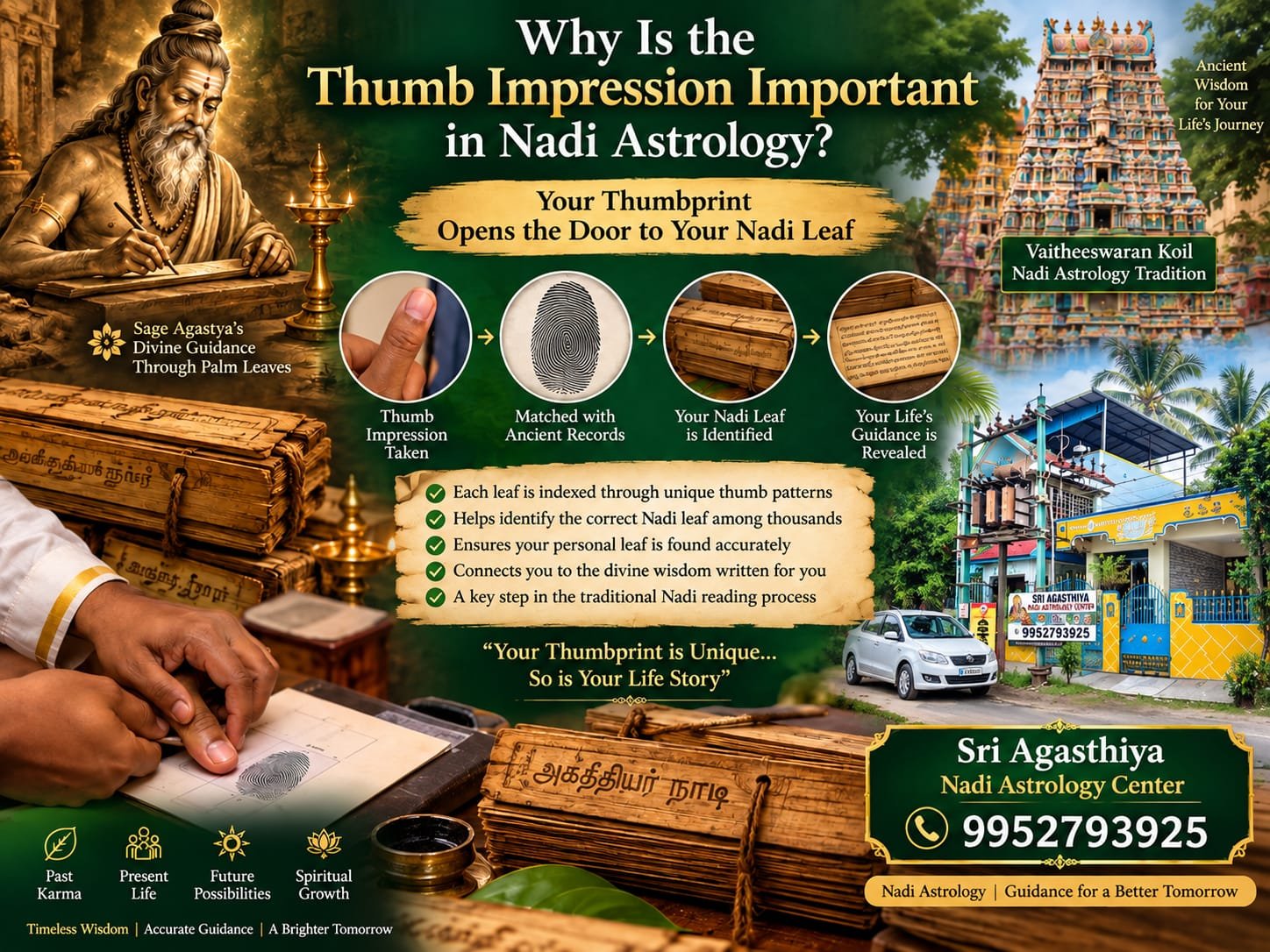
A traditional session commonly begins with the thumb impression of the person seeking the reading. In Nadi practice, thumb impressions are used as a way of placing individuals into particular categories that help the reader begin searching through groups of palm-leaf bundles. The impression itself is not presented as a complete prediction of a person’s future. Instead, within the tradition, it functions more like an initial reference point for selecting which collection of leaves should be examined first. After this starting category has been determined, the Nadi reader may bring out one or more bundles of preserved palm leaves. Each bundle can contain several individual leaves, so finding a possible match is usually a process rather than a single instant selection. This is where patience becomes an important part of the experience.
The reader then begins examining leaves from the selected bundle and traditionally asks a sequence of questions based on information written on them. These questions may concern personal or family details. Instead of immediately asking the visitor to provide a complete life history, the traditional identification method often works through confirmation. The reader presents information or asks questions, and the visitor confirms whether the details correspond to their life. A leaf that does not match is set aside and another is considered. In this way, the search gradually moves from a broad group of manuscripts toward a more specific possible match. Sometimes several leaves may need to be checked before the identification process reaches a conclusion. This is why a Nadi consultation should not be imagined simply as choosing a random palm leaf from a shelf. In the traditional method, the search and confirmation stage is itself an important part of the reading.
When a sequence of details is considered to correspond sufficiently with the visitor, that particular manuscript may be treated within the tradition as the person’s identified Nadi leaf. Only after this stage does the more detailed reading generally begin. Depending on the type of leaf and reading requested, the manuscript may traditionally discuss subjects such as family circumstances, education, career, marriage, finances, responsibilities, personal challenges, spiritual interests, or different stages of life. Some Nadi traditions also organize material into sections commonly known as Kandams, with different sections associated with different areas of life. The exact procedure, terminology, availability of leaves, and style of interpretation can vary between Nadi readers and centers, so not every consultation will follow precisely the same sequence.
The physical palm leaves themselves are also an important part of the atmosphere and heritage surrounding Nadi Astrology. Old manuscripts can carry visible signs of age, including changes in color, texture, and edges. Traditionally, writing was inscribed onto prepared palm leaves and the leaves were preserved together in bundles. Looking at such manuscripts gives a visitor a sense of how knowledge was recorded before modern books, computers, and digital databases became common. The importance of these leaves is therefore not limited to astrology alone; they also represent an old manuscript culture in which information was carefully written, bundled, protected, copied, and passed through generations. Because of their age and fragile nature, preservation and responsible handling are important wherever genuinely old manuscripts are maintained.
Vaitheeswaran Koil in Tamil Nadu has become strongly associated with Nadi Astrology traditions, and many people visiting the area encounter centers offering palm-leaf readings. For visitors, understanding the identification process beforehand can make the consultation less confusing. The thumb impression begins the traditional classification, the relevant bundles are searched, candidate leaves are examined, identifying statements are checked, and a possible matching leaf is selected before its contents are interpreted in greater detail. Seeing the process as these connected stages is more useful than expecting the reader to immediately produce a leaf carrying a person’s name the moment they arrive.
It is also helpful to approach Nadi Astrology with both cultural respect and thoughtful judgment. Nadi Astrology belongs to a long-standing spiritual and astrological tradition, but claims about a manuscript accurately describing an individual’s past or predicting their future should not be confused with scientifically established evidence. A reading can be approached as a traditional, cultural, spiritual, or personal experience without treating every statement as guaranteed fact. Important decisions involving health, education, money, legal matters, or other major life choices are better made using appropriate professional advice and reliable information alongside any personal spiritual beliefs.
At a traditional Nadi consultation, communication between the reader and visitor also matters greatly. A responsible explanation should help the visitor understand what is happening at each stage rather than creating unnecessary fear or pressure. The reader can explain why the thumb impression is being collected, how bundles are selected, why several leaves may be checked, and how the confirmation stage works. This transparency allows the visitor to appreciate the traditional method while making their own decisions about how much meaning they wish to place on the reading.
For people learning about this practice through Guruji Ramesh Swamy, the traditional Nadi leaf identification process can be understood as a journey with several connected stages: beginning with the thumb impression, moving through the selection of palm-leaf bundles, checking information through a question-and-confirmation process, identifying a possible matching manuscript, and finally proceeding to the detailed reading. Each stage has its own place within the tradition. The most interesting part is not simply the final leaf but the method through which the search is carried out. Ancient palm leaves, the memory of Siddhar traditions, the cultural connection with Vaitheeswaran Koil, and the careful process of examining manuscripts together create an experience that feels very different from many modern forms of astrology.
Ultimately, understanding the traditional Nadi leaf identification process means understanding that the reading is presented as more than a prediction session. It is a manuscript-search tradition shaped by old methods of recording knowledge, generations of preservation, spiritual beliefs, and a distinctive system of identification. Whether someone approaches it because of faith, family tradition, historical curiosity, or an interest in Nadi Astrology, knowing how the process works helps them experience it with greater clarity. The thumb impression provides the traditional starting point, the bundles provide the field of search, confirmation helps narrow the possibilities, and the selected palm leaf becomes the focus of the subsequent reading. In that sense, the identification journey itself is what gives a traditional Nadi consultation its unique character—connecting a modern visitor with a practice centered on palm leaves, inherited knowledge, and an enduring part of Tamil cultural tradition.