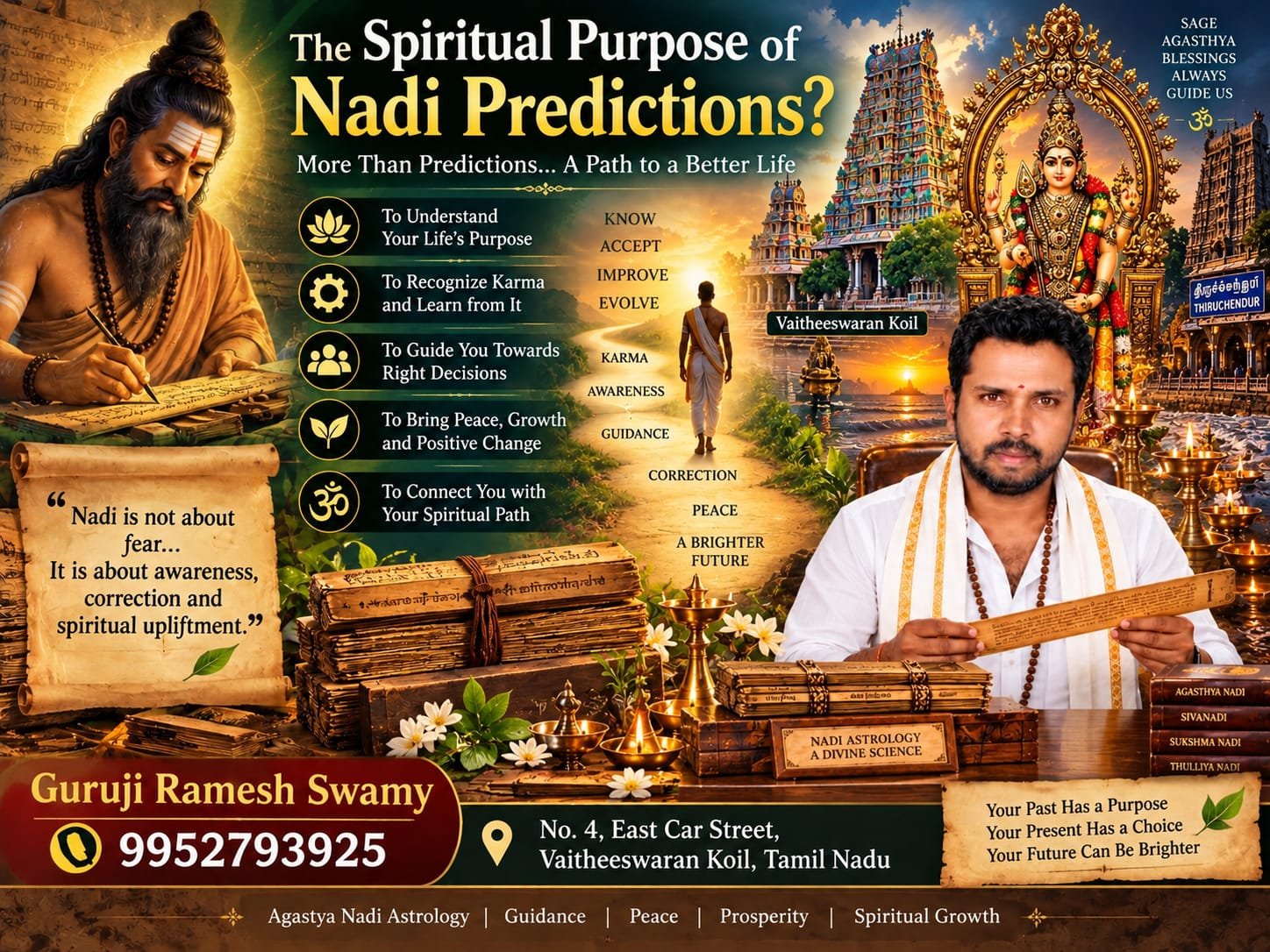
Nadi Astrology is often introduced as an ancient system of prediction, but its spiritual purpose can be understood as something broader than simply asking what may happen tomorrow. In the traditional view associated with palm-leaf readings, a Nadi prediction is meant to encourage a person to reflect on life, understand recurring patterns, recognize responsibilities, and approach the future with greater awareness. The palm leaves associated with the Nadi tradition are regarded by believers as carrying the wisdom of ancient sages such as Agastya, and for many people the experience of a reading is therefore not only about curiosity regarding future events but also about exploring questions of karma, purpose, relationships, work, family, personal choices, and spiritual growth. From this perspective, the value of a Nadi reading does not have to depend on treating every statement as an unavoidable event. Instead, it can serve as a moment of reflection in which a person considers where they are now, what has shaped their present circumstances, and what kind of decisions they would like to make going forward. The spiritual idea of karma is particularly important in many interpretations of Nadi Astrology. Karma is sometimes misunderstood as a fixed punishment or an unchangeable destiny, whereas within many Indian spiritual traditions it can also refer more broadly to action and its consequences. Seen in this way, thinking about karma can encourage personal responsibility rather than fear. Past actions may have consequences, present circumstances may contain lessons, and present choices may influence what comes next. A Nadi prediction can therefore be approached as guidance for self-examination rather than as a reason to surrender control over one’s life. This distinction matters because spiritual guidance becomes more meaningful when it encourages thoughtful action. If a reading speaks about challenges in family life, career, finances, education, relationships, or personal development, the constructive response is not necessarily to worry about the prediction; it may instead be to consider what practical improvements can be made today. A person can communicate more patiently, plan more carefully, learn new skills, correct avoidable mistakes, seek appropriate professional advice when needed, and make decisions based on both reflection and real-world information. In that sense, the deeper spiritual purpose of a prediction may be awareness: becoming more conscious of one’s habits, priorities, strengths, responsibilities, and direction in life. Traditional Nadi consultations are also connected with the idea that life contains both experiences we cannot fully control and choices for which we remain responsible. This creates an important balance between destiny and free will. A prediction may describe possibilities or traditional interpretations, but an individual still has the ability to think, question, choose, and act. Spiritual maturity does not mean waiting passively for predicted events to occur; it can mean responding to uncertainty with patience, discipline, compassion, and clarity. Another important purpose associated with Nadi guidance is inner correction. In a spiritual context, correction need not mean that a person is fundamentally flawed. It can simply mean recognizing attitudes or behaviors that are no longer helpful and making a sincere effort to improve them. Someone who repeatedly becomes angry may work toward patience; someone who neglects responsibilities may become more disciplined; someone who is overwhelmed by uncertainty may learn to separate what can be changed from what cannot be controlled. In this way, spiritual guidance can become practical rather than merely symbolic. Traditional readings may also include references to prayers, temple worship, charity, or other devotional practices. People who follow these traditions may regard such practices as ways of expressing gratitude, humility, devotion, or a commitment to positive change. They should not replace appropriate medical, legal, financial, educational, or other professional help when those are needed. The spiritual meaning lies in how sincerely a person reflects and acts, rather than in expecting a ritual alone to guarantee a particular outcome. The ancient Nadi tradition associated with Vaitheeswaran Koil, Tamil Nadu, continues to attract people interested in palm-leaf astrology and its cultural and spiritual background. For believers and visitors, the atmosphere of temples, palm-leaf manuscripts, traditional readers, lamps, prayers, and stories of the Siddhars can create a strong connection with the past. Yet the most useful question after receiving any prediction may be a very simple one: “What can I learn from this?” That question changes the focus from fear of the future to understanding the present. A prediction concerning success can become a reminder not to become careless; a prediction concerning difficulty can encourage preparation rather than panic; a discussion of relationships can encourage better communication; and a reference to spiritual development can inspire greater kindness, self-discipline, gratitude, and service to others. The future always contains uncertainty, and no spiritual reading should remove a person’s ability to evaluate evidence and make their own decisions. This is why the spiritual purpose of Nadi predictions can be expressed through four connected ideas: know, accept, improve, and evolve. Know yourself and your circumstances as clearly as possible. Accept what cannot be changed without allowing acceptance to become helplessness. Improve what is within your control through responsible choices and consistent effort. Evolve by carrying the lessons of experience into the next stage of life. These principles transform prediction into reflection and reflection into purposeful action. They also explain why people may seek a Nadi consultation during periods of confusion or transition: sometimes the deeper need is not simply to hear what will happen, but to find a framework for thinking about where life is heading. A responsible consultation should therefore leave room for questions, personal judgment, and practical decision-making. Guruji Ramesh Swamy – 9952793925, at No. 4, East Car Street, Vaitheeswaran Koil, Tamil Nadu, is presented in this context as part of the traditional Nadi Astrology practice. Those interested in such a consultation can approach it as an opportunity to learn about the tradition while keeping their own judgment at the center of important life decisions. Ultimately, the spiritual purpose attributed to Nadi predictions is not merely to reveal a mysterious future. It is to encourage awareness of the past without becoming trapped by it, attention to the present without wasting it, and hope for the future without assuming that everything is predetermined. Ancient wisdom can provide a language for reflection, but each person still lives their life through the choices they make every day. When Nadi Astrology is approached in that spirit, its message becomes less about fear and more about awareness, less about waiting and more about responsible action, and less about trying to control every future event and more about developing the wisdom to meet life thoughtfully. The past may offer lessons, the present offers opportunities to choose, and the future remains a path shaped by circumstances, actions, relationships, and decisions. That combination of reflection, responsibility, devotion, and personal growth is one way to understand the deeper spiritual purpose behind Nadi predictions.