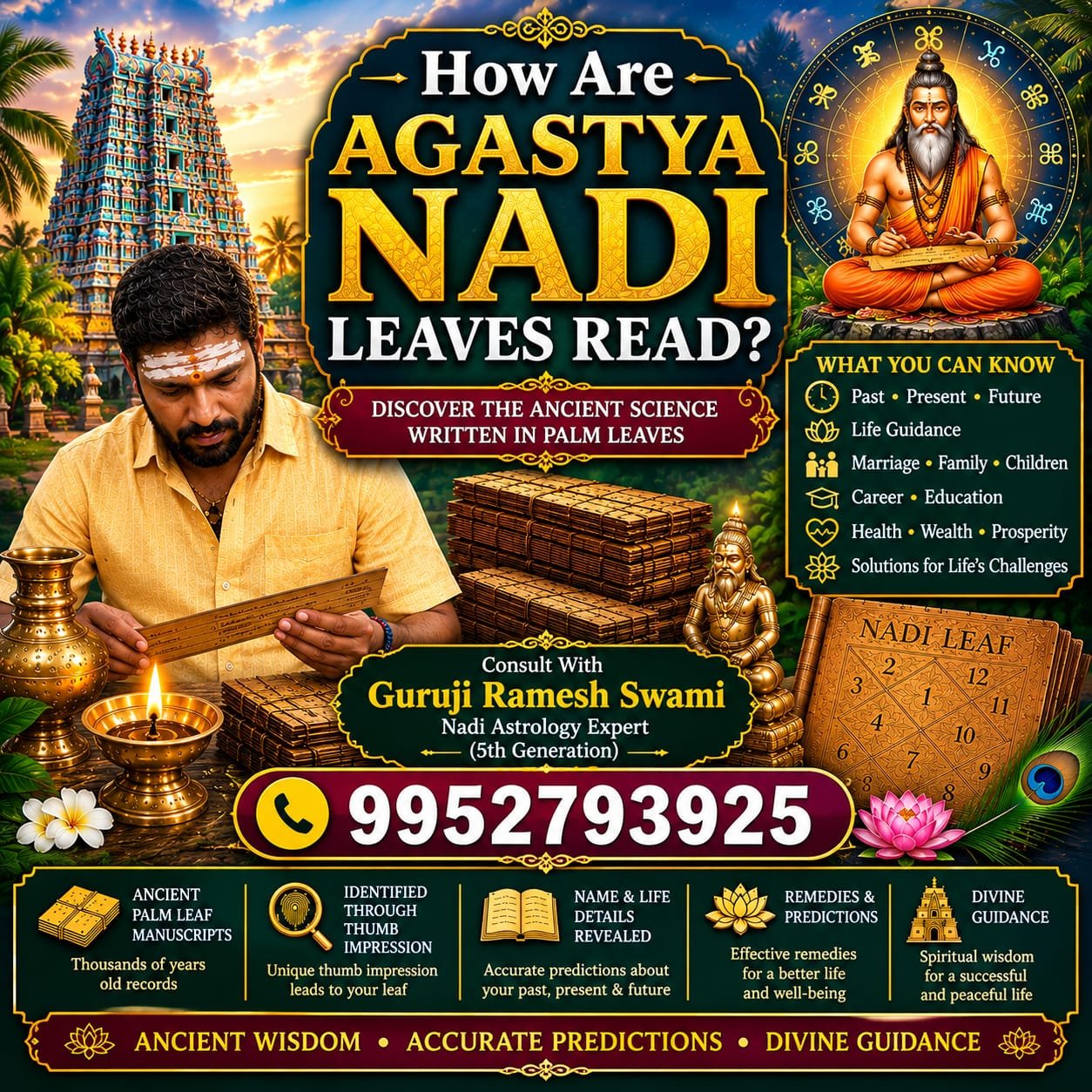
Agastya Nadi reading is an ancient spiritual tradition associated with palm-leaf manuscripts that are traditionally believed to contain insights connected with the lives and destinies of individuals. The tradition is closely linked with Sage Agastya, one of the respected sages of Indian spiritual heritage. Unlike a conventional horoscope consultation, where an astrologer usually begins with a person’s date, time, and place of birth, an Agastya Nadi reading traditionally starts with the search for a matching palm leaf. This identification process is one of the most distinctive features of Nadi Astrology. According to the traditional belief surrounding the practice, ancient sages perceived information about certain individuals and their life journeys and preserved this knowledge in poetic or symbolic form on palm leaves. Over generations, these manuscripts were copied and preserved by families and practitioners associated with Nadi reading traditions.
The process usually begins when a person approaches a traditional Nadi reader seeking guidance. In many Nadi traditions, the thumb impression of the seeker is used as an initial method of classification. Different patterns in the thumb impression are traditionally grouped into categories, and the reader uses the appropriate category to begin searching among bundles of palm leaves. The thumb impression itself is not considered the complete reading. Instead, it functions more like a starting reference that helps narrow the search. A bundle may contain several leaves, so finding a possible match can involve examining multiple manuscripts rather than immediately selecting one leaf.
Once a suitable bundle has been chosen, the identification stage begins. During this stage, the Nadi reader may read statements from individual leaves and ask the seeker to respond with simple confirmations such as “yes” or “no.” The statements can relate to general personal or family information. Rather than asking the seeker to explain their entire background first, the traditional method attempts to identify the correct manuscript through a process of confirmation. If several statements on a particular leaf do not correspond with the seeker, the reader may move to another leaf and continue the process. In this way, the search gradually becomes narrower until a leaf considered to correspond with the individual is identified.
After a matching leaf is believed to have been found, the reader begins interpreting its contents. Traditional Nadi manuscripts may be written in older forms of Tamil or in poetic language that is not always easy for a modern reader to understand directly. Therefore, an experienced Nadi reader has an important role not only in reading the written characters but also in explaining their meaning in contemporary language. The original verses may contain traditional astrological terminology, symbolic expressions, references to planets, family circumstances, spiritual concepts, or particular phases of life. The reader generally interprets these passages and communicates them in a way that the seeker can understand.
A complete Agastya Nadi consultation may be divided into sections traditionally known as Kandams. Each Kandam is associated with a particular area of life. The general section can provide an overall description of the person’s life, while other sections may focus on subjects such as education, career, marriage, family, children, finances, property, parents, siblings, spiritual development, or other traditional areas of inquiry. A person does not necessarily have to request every Kandam. Depending on the purpose of the consultation, the seeker may choose to explore the sections that are most relevant to the questions they have at that time.
The general Kandam often plays an important role because it provides the foundation for understanding the rest of the reading. Traditionally, it may contain information concerning different stages of life and major areas of personal experience. Once this section has been interpreted, additional Kandams may provide more focused explanations. For example, someone interested primarily in marriage may request the section associated with marital life, while another person concerned about professional direction may focus on the career-related section. This structure makes the reading more organized and allows different areas of life to be considered separately.
Another significant idea within the Agastya Nadi tradition is karma. Nadi readings are traditionally understood not merely as lists of future events but as spiritual interpretations of how actions, circumstances, choices, and consequences may be connected. Some readings may contain references to previous karma or spiritual responsibilities according to the beliefs of the tradition. When difficulties are interpreted through this framework, certain spiritual practices or remedies, commonly called Pariharams, may sometimes be suggested. These can involve traditional forms of prayer, temple worship, charitable actions, or other devotional practices. Such recommendations belong to the spiritual and religious framework of Nadi Astrology and should be understood in that context rather than as scientifically established treatments or guarantees of particular outcomes.
Timing is another interesting element of traditional Nadi interpretation. A manuscript may refer to periods of life during which particular developments are expected to become important. The Nadi reader may interpret these periods with reference to the astrological language found on the leaf. However, traditional predictions should not be treated as unavoidable instructions that remove personal choice. People continue to make decisions based on their circumstances, responsibilities, knowledge, and opportunities. For many seekers, a Nadi reading is therefore approached as a form of traditional or spiritual guidance rather than a substitute for practical decision-making.
The preservation of the leaves is also central to the reading tradition. Palm leaves are natural materials that can deteriorate over time, so historically many manuscripts had to be recopied to preserve their contents. This means that the physical leaf read today is not necessarily assumed to be the exact original leaf written in ancient times. Rather, the tradition holds that the information was transmitted through generations of manuscript preservation. Reading these manuscripts requires familiarity with the script, vocabulary, poetic structure, and interpretive customs associated with Nadi Astrology.
Modern technology has also changed how some people access Agastya Nadi readings. Traditionally, seekers travelled to places associated with Nadi manuscripts and met readers in person. Today, some practitioners provide remote consultations in which thumb impressions and other necessary information are exchanged digitally, followed by a reading through a phone or video call. Although the method of communication has changed, practitioners who follow the traditional system generally describe the fundamental stages as remaining similar: classification, leaf searching, identification, interpretation, and explanation.
What makes the reading of Agastya Nadi leaves particularly fascinating is the combination of manuscript tradition, astrology, spirituality, oral interpretation, and personal inquiry. The process is not simply a matter of opening a palm leaf and reading a ready-made biography. It traditionally involves searching through classified manuscripts, testing possible matches through confirmation, identifying a relevant leaf, interpreting older language, and then explaining different sections to the seeker. Whether someone approaches Nadi Astrology because of cultural interest, family tradition, spiritual curiosity, or a desire for personal guidance, understanding this process helps them appreciate the historical and traditional context behind the practice.
Ultimately, an Agastya Nadi leaf reading represents a continuing connection between an old manuscript tradition and the questions people ask about their lives today. Its significance for believers lies not only in predictions but also in ideas about karma, responsibility, spiritual reflection, and the direction of one’s life. The palm leaves, the reader, and the seeker each play a different role in the traditional process. The leaves preserve the written material, the reader interprets it, and the seeker decides how to understand and apply the guidance. In this sense, Agastya Nadi reading remains an intriguing example of how ancient spiritual traditions continue to be interpreted within the modern world.