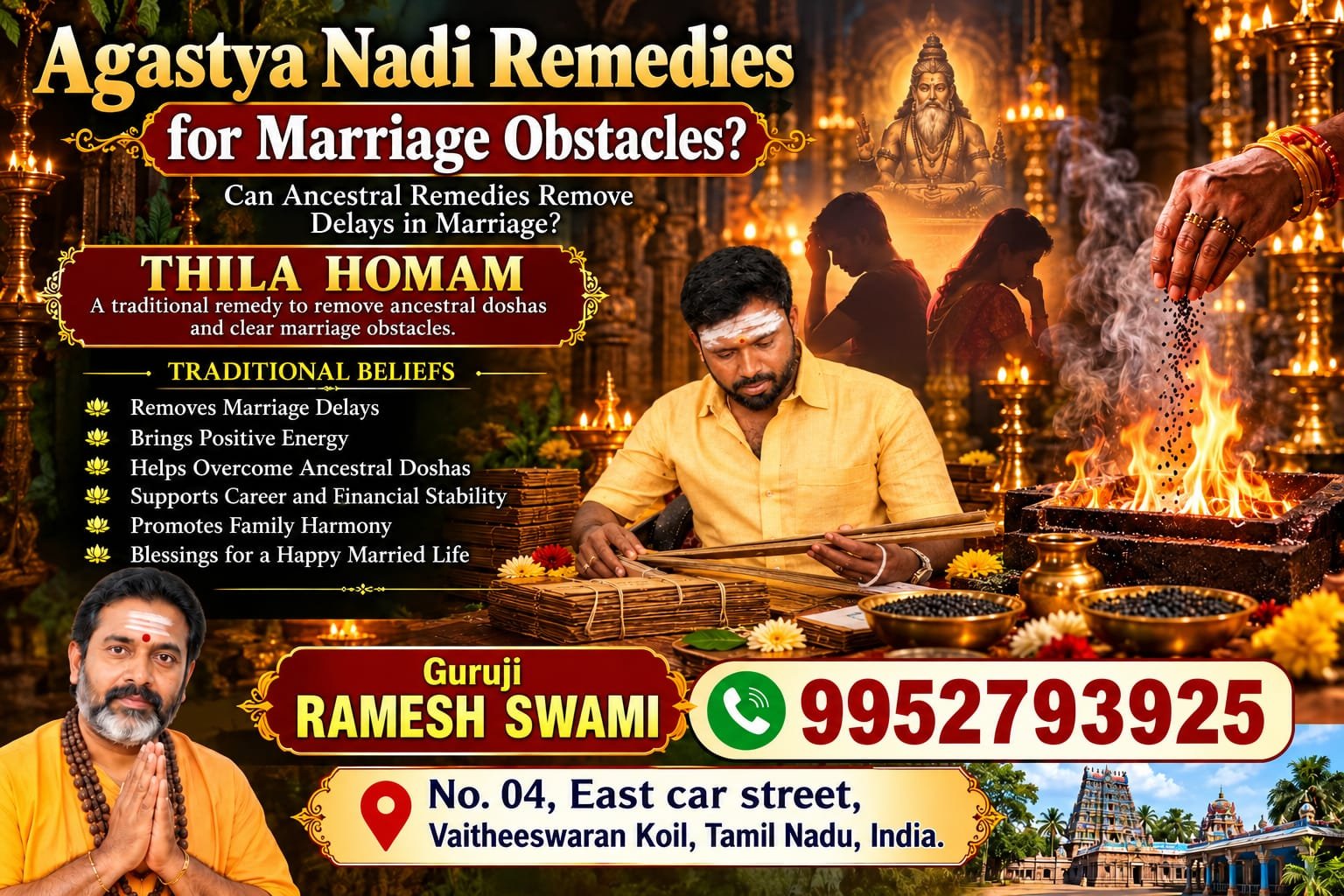
Agastya Nadi Astrology is an ancient spiritual tradition associated with the wisdom preserved in palm-leaf manuscripts, and many people approach this tradition when they wish to understand why certain areas of life, especially marriage, appear to face repeated delays, misunderstandings, unexpected interruptions, or emotional uncertainty. According to traditional Nadi beliefs, marriage is viewed not merely as a social event but as an important stage in a person’s life journey, influenced by individual choices, family circumstances, timing, responsibilities, and what the tradition describes as karmic patterns. When someone experiences difficulty finding a suitable partner, repeated cancellation of marriage proposals, disagreement between families, uncertainty in relationships, or unexplained delays even after considerable effort, a traditional Nadi consultation may be sought for spiritual guidance. In the Agastya Nadi tradition, the reading of a palm leaf is believed to provide insights connected with different areas of life, including family, profession, relationships, marriage, and spiritual development. A traditional reader may also discuss remedies that have historically been followed as devotional practices. These remedies should be understood as matters of faith and tradition rather than scientifically proven methods for guaranteeing a marriage or changing future events. One remedy sometimes discussed in connection with ancestral traditions is Thila Homam, a Hindu ritual involving prayers and offerings associated with remembrance and respect for ancestors. Within traditional belief, unresolved ancestral obligations or Pitru-related concerns may sometimes be interpreted as one of several spiritual influences connected with obstacles in family life. Thila Homam therefore holds significance for some devotees as an act of remembrance, gratitude, prayer, and spiritual peace. The purpose of such a ritual is not simply to ask for an immediate marriage but to approach family and ancestral responsibilities with devotion and respect. People may perform prayers, temple worship, charitable activities, offerings, or other customary practices depending on the guidance of their family tradition and qualified religious practitioners. Agastya Nadi remedies may similarly include forms of worship, prayer, acts of charity, visits to particular temples, or devotional observances. The exact practice can differ from person to person because traditional Nadi readings are generally presented as individualized rather than as one universal remedy for everyone experiencing marriage delays. This is why a responsible consultation should clearly explain what is being recommended, why it belongs to the tradition, and whether there are any costs involved before a person decides to proceed. The ancient palm leaves themselves are an important symbol within Nadi tradition. Traditionally, bundles of leaves are examined through an identification process in which statements or questions may be used to locate a leaf believed to correspond to the individual seeking a reading. Once a matching leaf is considered identified, its contents are interpreted and explained. For people consulting specifically about marriage, the discussion may focus on traditional interpretations of marriage timing, compatibility, family circumstances, possible challenges, and suggested spiritual practices. However, important personal decisions should not depend exclusively on an astrological reading. Communication between prospective partners, mutual respect, consent, emotional readiness, education, financial circumstances, family considerations, and practical compatibility all remain important when considering marriage. Spiritual guidance can be meaningful to someone who follows the tradition, while practical judgment should continue alongside it. Vaitheeswaran Koil in Tamil Nadu has long been associated with Nadi astrology traditions, and visitors often connect the area with palm-leaf reading practices and stories surrounding sages such as Agastya. The temple atmosphere, traditional manuscripts, generations of readers, and devotional customs have contributed to the cultural identity surrounding Nadi astrology in the region. For those interested in learning about traditional approaches to marriage-related questions, a consultation can therefore be viewed as an opportunity to explore a spiritual and cultural perspective rather than as a guaranteed prediction. Guruji L. Ramesh Swamy offers Nadi astrology consultations in Vaitheeswaran Koil and can be contacted at 9952793925, with the address No. 04, East Car Street, Vaitheeswaran Koil, Tamil Nadu, India. During a consultation, it is useful for visitors to ask clearly about the reading process, what a suggested remedy involves, and any associated arrangements before agreeing to it. A meaningful spiritual consultation should encourage understanding rather than fear. Marriage delays can happen for many ordinary reasons, and they should not automatically be treated as evidence of a dosha, curse, or ancestral problem. Likewise, no genuine spiritual practice can responsibly promise that performing one ritual will guarantee marriage within a particular period. The deeper value that devotees may find in traditional remedies can instead lie in prayer, reflection, gratitude toward ancestors, renewed confidence, and a more thoughtful approach to personal and family responsibilities. For someone who believes in Agastya Nadi traditions, remedies connected with marriage obstacles can become part of a broader spiritual journey—one that encourages patience, self-understanding, respect for relationships, and hope while still recognizing the importance of real-world choices. Marriage is a significant commitment involving two people and often two families, so approaching it with clarity and patience can be as important as seeking spiritual guidance. The enduring appeal of Agastya Nadi Astrology comes from its combination of ancient palm-leaf tradition, spiritual symbolism, cultural heritage, and individualized storytelling about a person’s life journey. Whether someone visits Vaitheeswaran Koil because of marriage concerns or simply wishes to understand this historic tradition, the experience can offer an opportunity to reflect on the past, examine present circumstances, and think carefully about the future. When remedies such as prayers or Thila Homam are discussed, they are best approached respectfully as traditional religious practices, without replacing practical action or expecting guaranteed outcomes. In this way, Agastya Nadi Remedies for Marriage Obstacles can be understood not as a promise to magically remove every difficulty, but as a traditional spiritual framework through which believers may seek guidance, devotion, reflection, and peace while continuing to make thoughtful decisions about marriage and life.