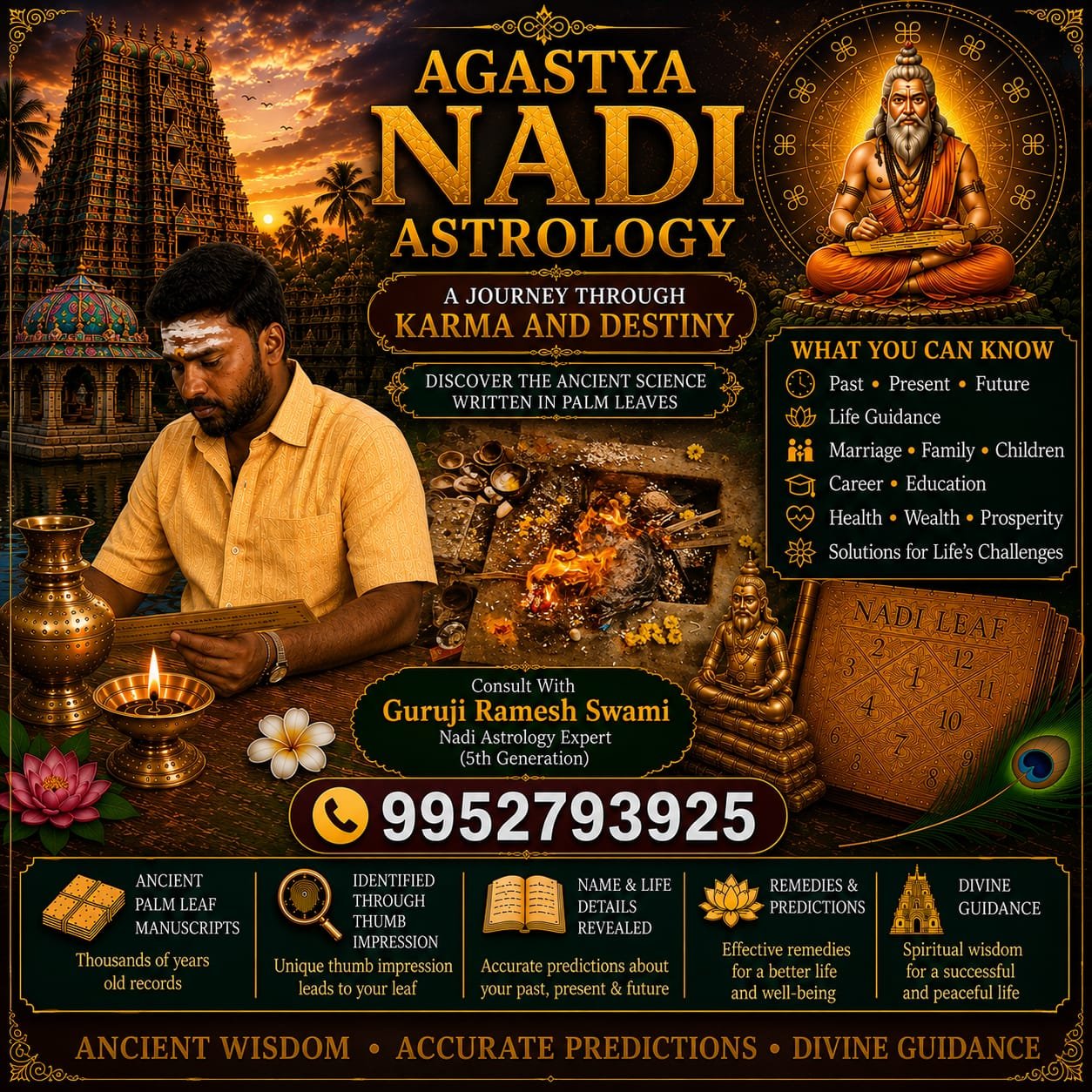
Agastya Nadi Astrology is a fascinating traditional system of spiritual astrology that connects the mysteries of human life with the ancient concepts of karma, destiny, and divine guidance. Associated with the revered Sage Agastya, this tradition is popularly linked with palm-leaf manuscripts preserved in South India. According to traditional belief, great sages possessed extraordinary spiritual insight and recorded information concerning the lives of certain individuals who would seek this knowledge in future generations. These records are believed to contain guidance about different stages of life, including family, education, career, marriage, finances, relationships, spiritual development, and other significant experiences. For people who follow this tradition, an Agastya Nadi reading is not simply an attempt to know what will happen tomorrow. It represents a journey of understanding why certain situations appear in life, how past actions may be connected with present circumstances, and how present choices can influence the path ahead. The concept of karma plays an important role in this understanding. Karma can broadly be understood as the relationship between actions and their consequences. Every decision, intention, responsibility, and interaction can create effects that shape future experiences. Within the spiritual framework of Nadi Astrology, some circumstances in the present may be interpreted as connected to karmic patterns. This does not necessarily mean that every difficult experience should be regarded as punishment. Instead, challenges may be viewed as opportunities for learning, correction, maturity, compassion, patience, or spiritual development. The Nadi tradition therefore encourages a person to look beyond the immediate surface of an experience and consider what it might teach them about their own journey.
Destiny is another central idea in Agastya Nadi Astrology. Many people understand destiny as something completely fixed, but the traditional relationship between destiny and karma can be viewed in a more thoughtful way. Destiny may describe certain circumstances, opportunities, relationships, responsibilities, and turning points that appear along life’s path, while personal choices influence how a person responds to those circumstances. Imagine destiny as a road containing many different landscapes. Some parts may be comfortable, others challenging, and some may offer unexpected opportunities. The traveller still has to decide how carefully to move, what lessons to learn, and how to react to each situation. In this sense, Agastya Nadi Astrology can be approached as a traditional form of guidance rather than a command that removes personal responsibility. A prediction may encourage reflection, but important decisions concerning education, career, finances, relationships, or well-being should still be made thoughtfully and with appropriate practical information.
The palm leaves themselves are among the most recognizable elements of Nadi Astrology. Palm leaves were historically used as writing materials in India, and many forms of traditional knowledge were preserved through manuscripts. Because natural palm leaves can deteriorate over time, manuscripts were often recopied by later generations. Nadi Astrology exists within this broader manuscript culture, although its specific predictive claims belong to spiritual tradition rather than scientifically established knowledge. In a traditional Agastya Nadi consultation, the process may begin with the seeker’s thumb impression. The impression is classified according to traditional patterns, helping the reader search through particular bundles of manuscripts. This is an unusual characteristic of Nadi Astrology because the consultation may not begin in exactly the same manner as conventional horoscope astrology.
After selecting a possible bundle, the reader may begin the identification process. Statements from different leaves can be presented to the seeker, who generally confirms whether the information corresponds with their circumstances. When a leaf does not appear to match, another may be examined. The process can continue until a manuscript believed to correspond to the seeker is identified. Traditional manuscripts may use older language, poetic structures, symbols, and astrological terminology, so the Nadi reader has the responsibility of interpreting and explaining the material in understandable language. In this way, the reader serves as an intermediary between an old manuscript tradition and a modern seeker.
Agastya Nadi readings are traditionally organized into sections often called Kandams. Different Kandams deal with different dimensions of life. One may provide a general overview, while others may address education, profession, marriage, children, family matters, parents, finances, spiritual development, or other areas. This division reflects an important feature of the tradition: human destiny is not treated as one single event. Life is considered a collection of interconnected experiences. Career decisions can influence family life; education can affect professional opportunities; relationships can influence emotional development; and personal values can shape the choices made during important periods. Looking at these areas separately while recognizing their connections gives the Nadi reading its distinctive structure.
Karma becomes especially significant when a reading discusses difficulties or recurring patterns. From the traditional perspective, some obstacles may be interpreted through karmic ideas. Certain readings may also recommend Pariharam, meaning spiritual or devotional remedies. Depending on the tradition, these might include prayer, charitable activities, temple worship, acts of service, or other devotional practices. These recommendations belong to religious and spiritual belief and should not be regarded as guaranteed methods for producing specific outcomes. Their deeper traditional purpose can be interpreted as encouraging discipline, generosity, humility, reflection, and positive action. If a person responds to a difficult period by becoming more responsible and compassionate, the spiritual value may lie in that transformation itself.
The idea of time also makes the relationship between karma and destiny interesting. The past cannot be physically rewritten, but lessons from previous experiences can influence present decisions. The future cannot be known with certainty, but present actions can help create better possibilities. The present therefore becomes the meeting point between karma and destiny. Yesterday may have contributed to today’s circumstances, while today’s decisions can contribute to tomorrow’s experiences. From this perspective, the most valuable question is not simply, “What will happen to me?” It can also become, “How should I respond wisely to what is happening now?”
Modern life has changed the way people encounter Nadi Astrology. Traditionally, seekers might travel to locations in Tamil Nadu associated with palm-leaf reading traditions and meet practitioners directly. Today, some consultations are also offered remotely using digital communication. Technology may change the method through which people communicate, but the fundamental human questions remain familiar: What is my purpose? Why am I facing this challenge? What direction should I choose? What can I learn from my experiences? What kind of future am I building through my present actions?
Ultimately, Agastya Nadi Astrology: A Journey Through Karma and Destiny is best understood as an exploration of an ancient spiritual tradition in which human experiences are interpreted through the interconnected themes of action, consequence, responsibility, destiny, and self-reflection. Its cultural appeal comes from the mysterious palm-leaf manuscripts, the traditional identification process, the wisdom associated with Sage Agastya, and the belief that life’s events may carry deeper meaning. Yet perhaps its most thought-provoking message is that seeking knowledge of destiny does not eliminate the importance of the present. Whatever a palm leaf is believed to reveal, individuals still make choices, develop relationships, accept responsibilities, learn from mistakes, and determine how they respond to changing circumstances. Within this philosophical interpretation, karma represents what actions create, destiny represents the path that unfolds, and awareness represents the opportunity to travel that path with greater understanding. Thus, the journey through Agastya Nadi Astrology is not merely a search for predictions—it can also be seen as a traditional invitation to understand the past, live consciously in the present, and approach the future with responsibility, reflection, and hope.