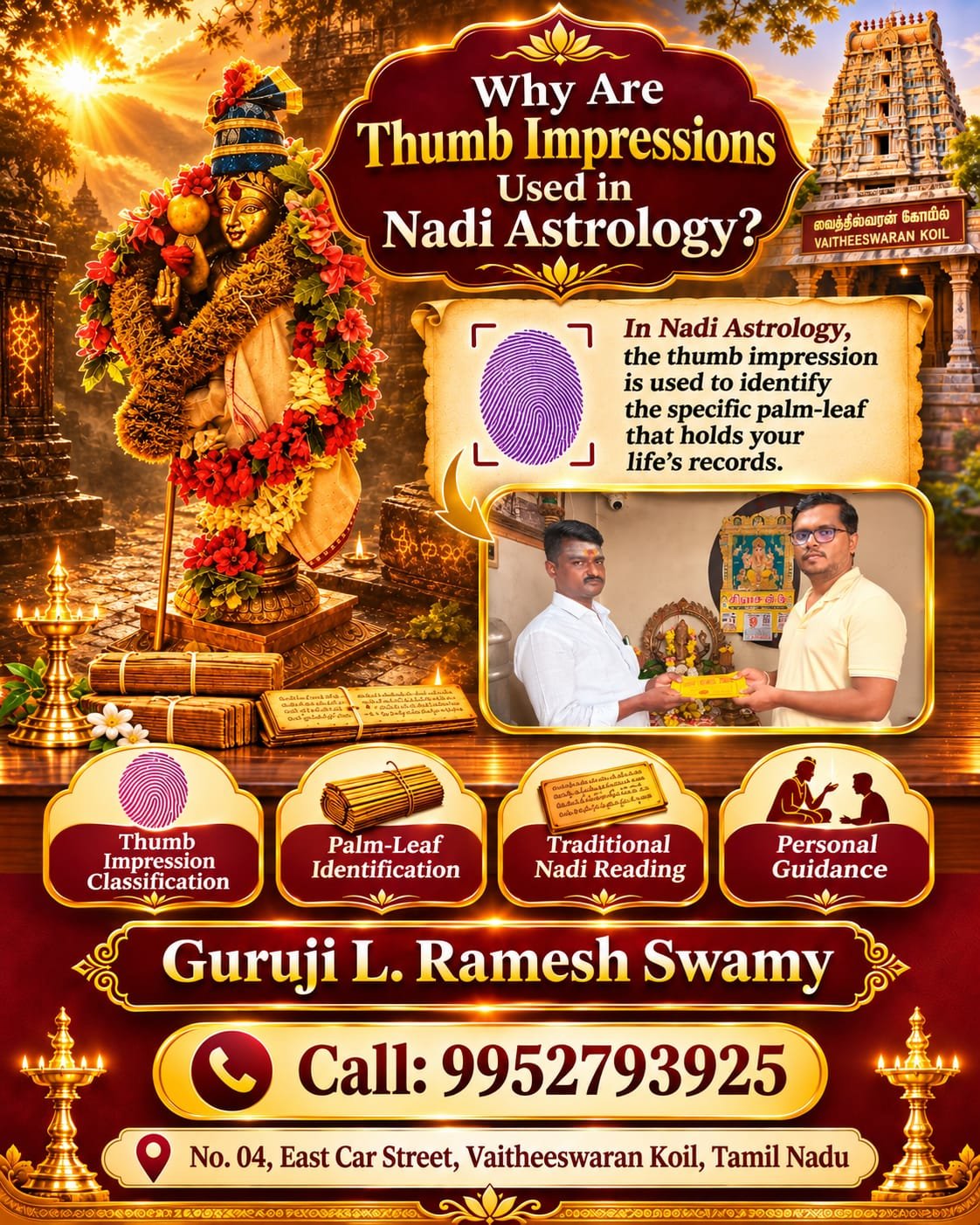
Why Are Thumb Impressions Used in Nadi Astrology? This question is often asked by individuals who are discovering the traditional Indian palm-leaf reading system for the first time. Nadi Astrology, also known as Nadi Jothidam or Nadi Josiyam, is a distinctive spiritual tradition closely associated with the ancient Tamil sages, particularly Sage Agathiyar, and the historic temple town of Vaitheeswaran Koil in Tamil Nadu, India. One of the most fascinating aspects of this tradition is the use of thumb impressions as the starting point for searching through collections of palm-leaf manuscripts. Unlike conventional horoscope astrology, which generally relies on the date, time, and place of birth, traditional Nadi Astrology uses a thumb impression classification method to guide the initial manuscript search. According to traditional Nadi beliefs, ancient sages preserved spiritual interpretations relating to different aspects of human life in palm-leaf manuscripts, including family relationships, marriage, education, career, business, financial circumstances, children, spiritual responsibilities, and possible future experiences. These interpretations are part of a cultural and spiritual belief system rather than scientifically verified predictions of individual lives. The thumb impression process is traditionally considered important because it helps the Nadi reader organize the search among available bundles of palm leaves. In many Nadi Astrology traditions, the right thumb impression is collected from male seekers, while the left thumb impression is collected from female seekers. This practice is followed as part of an inherited classification system, although individual procedures may vary between traditional reading centers. The human thumb contains distinctive ridge patterns, including loops, whorls, arches, and variations in the arrangement of fingerprint lines. In scientific fingerprint identification, these patterns are used to distinguish individuals; however, their use in Nadi Astrology serves a different traditional purpose. Nadi readers generally use the thumb impression to identify a category associated with particular manuscript bundles rather than scientifically matching a fingerprint to an ancient document. Understanding this difference is essential for anyone interested in authentic explanations of the Nadi reading procedure. Once the thumb impression has been collected, the astrologer examines its visible pattern and determines the appropriate traditional classification. Based on this classification, the reader begins examining corresponding bundles of palm-leaf manuscripts available at the center. These manuscripts are traditionally preserved in groups, and the searching procedure may involve reviewing several leaves before a potentially relevant record is identified. The process is commonly known as Nadi Palm Leaf Identification or Nadi Leaf Searching. Visitors should understand that the number of manuscripts examined and the time required for searching may vary depending on the collection, the classification method, and the availability of suitable leaves. The astrologer may then begin a question-and-answer identification procedure in which statements from a particular manuscript are presented to the seeker. These statements may concern personal circumstances, family relationships, or other identifying information. The seeker is expected to respond accurately, usually by confirming whether each statement is correct or incorrect. Through this process, the reader attempts to determine whether a particular palm leaf corresponds to the individual receiving the consultation. In traditional belief, successful identification suggests that the appropriate manuscript has been located. Nevertheless, the procedure should be understood as a customary spiritual identification method, not a scientifically demonstrated system for determining a person’s past or future. A responsible Nadi Astrology practitioner should explain the process clearly and acknowledge that a matching palm leaf may not always be found. The traditional significance of thumb impressions extends beyond their practical use in manuscript classification. For many followers of Nadi Astrology, the thumb impression represents an individual connection with an ancient spiritual tradition that has been passed down through generations of readers. The process creates a sense of participation in a cultural practice that combines palm-leaf manuscripts, traditional interpretation, and personal reflection. In Vaitheeswaran Koil, this distinctive procedure has become closely associated with Agathiyar Nadi Astrology and continues to attract visitors who are interested in Tamil spiritual heritage. Palm-leaf manuscripts themselves also form an important part of South Indian literary history. Before modern printing technology became widely available, prepared palm leaves were used to record religious texts, medical knowledge, literature, philosophy, astronomy, and other subjects. Traditional Nadi manuscripts are associated with this broader history of palm-leaf writing and preservation. Understanding the physical appearance of these manuscripts, the ways in which they are stored, and the methods used to interpret their contents can help visitors appreciate the cultural background of Nadi readings. After a palm leaf is considered a match through the traditional identification process, the reader may explain the general chapter, commonly known as the General Kandam. This chapter is traditionally associated with personal and family information and may introduce other subjects discussed in the reading. Additional Kandams may explore marriage, children, education, employment, professional responsibilities, business, property, financial matters, travel, or spiritual practices, depending on the tradition and manuscripts available. Customers should enquire about which chapters are included in the initial consultation and whether additional readings involve separate charges. Thumb impression classification is also used in some online Nadi Astrology consultation arrangements. Individuals living in the United States, United Kingdom, Canada, Australia, Singapore, Malaysia, and other countries may enquire about submitting a thumb impression before participating in an online reading. However, fingerprints are sensitive biometric information, and customers should carefully consider how their impressions are collected, transmitted, stored, and eventually deleted. Before submitting any fingerprint image, a customer should ask the consultation provider about its privacy practices and whether the impression is genuinely necessary for the requested service. An online session may involve video communication, traditional manuscript searching, question-and-answer identification, and interpretation in an agreed language. Customers should confirm the available facilities rather than assume that every center follows an identical process. The relationship between thumb impressions and Nadi Astrology is especially interesting because it highlights the distinction between traditional belief and modern scientific understanding. Fingerprints can provide reliable identifying characteristics when processed through established forensic methods, but there is no accepted scientific evidence showing that fingerprint patterns reveal a person’s destiny or reliably identify manuscripts describing their future. Individuals can therefore appreciate the traditional practice without treating its predictive claims as established facts. At Sri Agasthiya Nadi Astrology Center, associated with Guruji L. Ramesh Swamy, individuals interested in learning about traditional Agathiyar Nadi palm-leaf readings can enquire about the thumb impression procedure, manuscript identification, available Kandams, and consultation arrangements. The center is located at No. 04, East Car Street, Vaitheeswaran Koil, Tamil Nadu, India. For enquiries regarding traditional Nadi Astrology services, visitors may contact Guruji L. Ramesh Swamy at +91 9952793925. Ultimately, the reason thumb impressions are used in Nadi Astrology is their traditional role in classifying and organizing the search for palm-leaf manuscripts. The process represents a distinctive feature of Agathiyar Nadi Jothidam and offers an opportunity to explore the relationship between inherited spiritual customs, ancient manuscript traditions, and personal cultural experiences. By understanding the purpose of thumb impression classification, the subsequent palm-leaf search, the question-and-answer method, and the importance of protecting personal information, visitors can approach traditional Nadi readings with greater awareness, realistic expectations, cultural respect, and confidence in their own independent decisions.