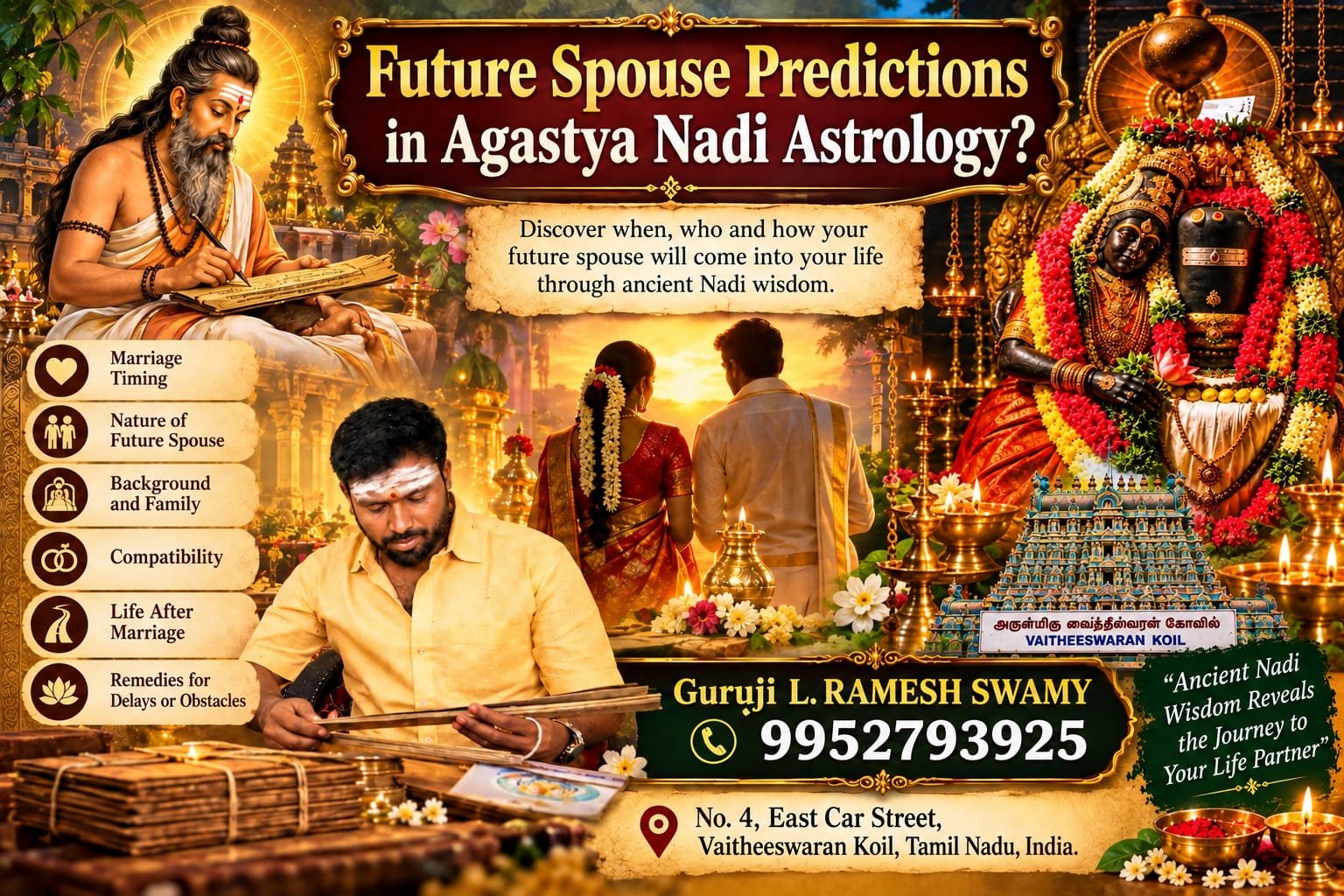
Future Spouse Predictions in Agastya Nadi Astrology is a traditional subject that attracts the interest of people who wish to understand marriage, relationships, and the possible qualities of their future life partner through the ancient Nadi tradition. Agastya Nadi Astrology is associated with old palm-leaf manuscripts and the spiritual heritage preserved in places such as Vaitheeswaran Koil in Tamil Nadu. According to this tradition, the palm leaves are believed to contain guidance connected with different areas of an individual’s life. Marriage is one of the important subjects discussed during many traditional Nadi readings because choosing a life partner and building a family can influence a person’s emotional, social, and spiritual journey. A future spouse reading is therefore not simply about asking for a name or expecting an exact picture of the person one may marry. Traditionally, the reading may explore broader themes such as the possible period of marriage, characteristics associated with a future spouse, family circumstances, compatibility, circumstances through which the relationship could develop, possible delays or obstacles, and guidance traditionally associated with married life. The purpose is often presented as gaining perspective rather than treating every statement as an unavoidable event. In the Agastya Nadi tradition, a seeker may first go through a leaf-identification process. Thumb-impression classification and a sequence of confirmation questions are traditionally used to search among groups of palm leaves for a manuscript believed to correspond to the individual. Once a suitable leaf is identified according to that process, its contents may be read and explained. Marriage-related sections are traditionally understood to contain information concerning relationships and family life. Depending on the manuscript and interpretation, a reading may discuss the likely nature of the future spouse, personality tendencies, family environment, educational or professional background, values, responsibilities, and the kind of understanding expected between partners. These descriptions should be approached as traditional astrological interpretations rather than scientifically established predictions. One reason people seek such readings is uncertainty about when marriage may happen. Some may be waiting for a suitable proposal, while others may wonder why previous discussions did not progress. Agastya Nadi Astrology traditionally approaches marriage timing by interpreting the information attributed to the identified palm leaf and related astrological factors. Rather than allowing a predicted period to create fear or pressure, it can be healthier to view such information as part of a cultural or spiritual consultation while continuing to make relationship decisions through communication, consent, compatibility, shared values, and practical judgment. Another area traditionally discussed is the nature of the future spouse. A reading may describe qualities such as calmness, confidence, responsibility, spirituality, affection toward family, or dedication to work. It may also discuss how two people could complement one another. These descriptions do not guarantee that a future partner will possess every stated characteristic. Human personalities are complex, relationships develop over time, and successful marriage depends greatly on how two individuals communicate and respect one another. Family background may also appear in traditional marriage readings. In Indian marriage traditions, families can play an important role, particularly in arranged marriages. Consequently, Nadi interpretations may touch upon family circumstances, cultural similarities, responsibilities, or the environment in which a marriage could develop. For someone considering a love marriage, the questions may be different: whether family acceptance is likely, how differences might be handled, or what challenges the couple may need to navigate. Regardless of the form of marriage, an astrology reading should never replace the free choice of either person involved. Compatibility is another commonly discussed theme. Traditional compatibility is broader than simply declaring two people suitable or unsuitable. A thoughtful interpretation may encourage reflection on temperament, expectations, financial responsibility, family priorities, emotional understanding, and long-term goals. These are areas couples can also discuss directly before making a major commitment. If an astrological interpretation raises concerns, it is better to treat those concerns as prompts for thoughtful conversation rather than as reasons for fear. Some Nadi traditions also discuss delays or obstacles related to marriage. These may be interpreted through ideas of karma, planetary influence, or unfinished responsibilities. Traditional spiritual remedies may sometimes be suggested, including prayer, temple worship, charity, or other devotional practices. Such practices can have personal religious or cultural meaning, but they should not be represented as guaranteed methods for producing a marriage or changing another person’s feelings. No ethical consultation should pressure someone into expensive rituals, promise a guaranteed spouse, or create anxiety by claiming that something terrible will happen without a particular remedy. The spiritual dimension of Agastya Nadi Astrology often emphasizes karma and personal responsibility. In this perspective, marriage can be viewed as one chapter within a larger life journey rather than merely a fixed event on a calendar. Meeting a partner may bring companionship as well as responsibilities, adjustments, lessons, and opportunities for personal growth. A traditional reading may therefore encourage patience and maturity alongside predictions. This can be especially meaningful for people who approach Nadi Astrology as part of their cultural heritage or spiritual practice. At Vaitheeswaran Koil, the Nadi tradition has become closely associated with palm-leaf reading, and visitors often seek consultations concerning marriage, career, family, and other life questions. A consultation with Guruji L. Ramesh Swamy – 9952793925 may be presented as an opportunity to explore this traditional system and understand how marriage-related passages are interpreted within the Nadi framework. A seeker can make the experience more useful by asking clear questions, listening carefully to the explanation, and distinguishing traditional belief from verifiable fact. It is also sensible to avoid giving unnecessary personal information before the identification process if one wishes to understand how the reading is being conducted. Most importantly, future spouse predictions should not become a source of pressure. Astrology cannot substitute for getting to know another person. Before marriage, practical considerations such as mutual respect, emotional safety, honest communication, education or career plans, financial expectations, family responsibilities, personal boundaries, and willingness from both individuals deserve careful attention. A palm-leaf reading may offer a traditional narrative about the future, but the real relationship will still be created through everyday decisions made by two people. The most constructive way to approach Future Spouse Predictions in Agastya Nadi Astrology is therefore with curiosity, cultural respect, and balanced expectations. Ancient palm leaves, temple traditions, and the teachings associated with Sage Agastya give Nadi Astrology its distinctive spiritual character, while modern seekers remain responsible for making their own relationship choices. Whether someone visits Vaitheeswaran Koil because of faith, family tradition, curiosity, or a desire for guidance, the experience can be treated as a chance for reflection rather than an unquestionable command about the future. Marriage is ultimately a shared journey that requires trust, consent, patience, understanding, and responsibility. In that broader perspective, a Nadi reading can serve as one traditional source of reflection while the individual continues to shape the future through thoughtful choices and meaningful relationships.