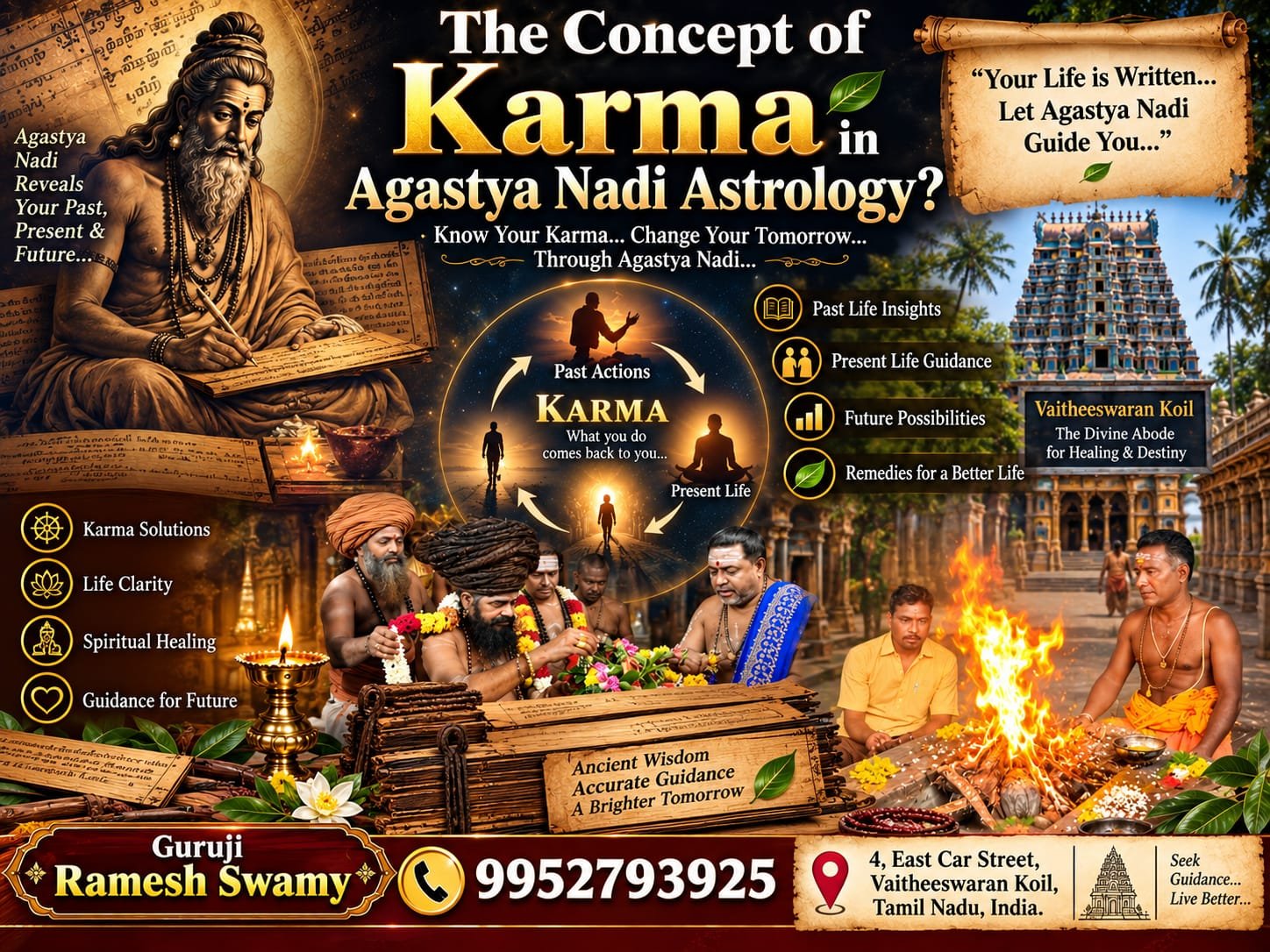
The concept of karma in Agastya Nadi Astrology can be understood as a spiritual way of looking at how a person’s actions, choices, intentions, responsibilities, and experiences may be connected across different stages of life. In the traditional understanding of Nadi Astrology, life is not always viewed as a collection of unrelated events. Instead, every experience may be considered part of a larger journey in which past actions influence present circumstances, while present choices help shape the direction of the future. Agastya Nadi Astrology is traditionally associated with ancient palm-leaf manuscripts and the wisdom attributed to Sage Agastya. Within this tradition, karma is often discussed not simply as punishment or reward, but as a principle of cause, consequence, learning, responsibility, and personal transformation. This distinction is important because karma does not necessarily mean that every difficulty in life should be viewed negatively. A challenging period may be interpreted as an opportunity to understand oneself more deeply, correct an unhealthy pattern, develop patience, fulfil an overlooked responsibility, or approach life with greater awareness. Similarly, a favourable period may be regarded as an opportunity to use one’s circumstances wisely rather than taking them for granted. The Nadi tradition commonly approaches human life through different areas such as family, education, career, marriage, finances, relationships, health, spiritual interests, and personal responsibilities. During a traditional reading, these areas may be discussed in relation to the individual’s life journey and the karmic themes described in the reading. The central idea is that the present moment stands between what has already happened and what has yet to unfold. What has happened cannot always be changed, but the way a person responds today can influence tomorrow. This gives the concept of karma a practical meaning: awareness can lead to better choices. For example, when someone repeatedly encounters similar conflicts, delays, misunderstandings, or emotional difficulties, a karmic interpretation may encourage that person to examine recurring habits and reactions rather than simply blaming circumstances. In this sense, karma becomes a mirror for reflection. It encourages questions such as: What can I learn from this experience? Is there a pattern that needs to change? Am I treating others fairly? Am I fulfilling my responsibilities? Are my current decisions taking me toward the kind of life I want to build? These questions can turn a spiritual concept into an opportunity for thoughtful self-examination.
In Agastya Nadi Astrology, the ideas of past, present, and future are often described as interconnected rather than completely separate. Traditional belief holds that some circumstances experienced in the present may have roots in earlier karmic actions. However, this does not have to be understood as saying that a person has no freedom. A more balanced interpretation is that circumstances may create a starting point, while present decisions determine how a person responds to that starting point. Two people may face similar difficulties but react in completely different ways. One may respond with anger and repeat the same pattern, while another may respond with patience, understanding, and careful action. Their future experiences can therefore develop differently. This is why personal responsibility occupies an important place in discussions about karma. Nadi guidance may encourage individuals to become conscious of their behaviour instead of becoming fearful about destiny. Traditional remedial practices may also be mentioned in some readings. Depending on the tradition and interpretation, these can include prayer, charitable acts, helping people in need, showing respect to parents and elders, visiting sacred places, practising gratitude, or performing particular devotional observances. Such practices are traditionally understood as ways of encouraging discipline, humility, compassion, and spiritual reflection; they should not be treated as guaranteed solutions to medical, financial, legal, or other practical problems. One of the meaningful aspects of the karmic philosophy is that positive action does not need to begin with something extraordinary. Speaking kindly, keeping promises, helping another person without expecting a reward, correcting a mistake, avoiding unnecessary harm, respecting family responsibilities, and acting honestly can all be viewed as constructive actions. Small decisions repeated consistently can gradually influence a person’s character and relationships. From this perspective, karma is not merely about discovering what happened in a supposed previous birth; it is equally concerned with how someone chooses to live now.
A traditional Nadi consultation may therefore be approached as an opportunity for reflection rather than as a reason to become anxious about the future. Guruji Ramesh Swamy – 9952793925 offers guidance connected with the Agastya Nadi Astrology tradition and palm-leaf reading. Those interested in this tradition may use a consultation to explore the spiritual interpretation of their life journey, recurring patterns, responsibilities, and possible future directions. At the same time, major decisions involving health, education, finances, marriage, career, or legal matters are best made using reliable practical information and appropriate professional advice alongside any spiritual guidance. The deeper message associated with karma is not that life is permanently fixed by the past. Rather, it invites a person to understand the past, become more conscious in the present, and approach the future with responsibility. Yesterday may provide the background, but today still contains choices. When those choices are guided by patience, honesty, compassion, discipline, and thoughtful action, the individual can develop a different relationship with both difficulties and opportunities. In this way, the concept of karma in Agastya Nadi Astrology becomes more than a prediction about destiny. It becomes a philosophy of awareness: understand the patterns behind your experiences, learn what those experiences can teach you, fulfil your responsibilities with sincerity, and use the present moment wisely. The palm leaf, in the traditional spiritual view, may describe a path, but the person walking that path still has decisions to make. Karma can therefore be seen not simply as something carried from the past, but also as something being created through every meaningful action in the present.