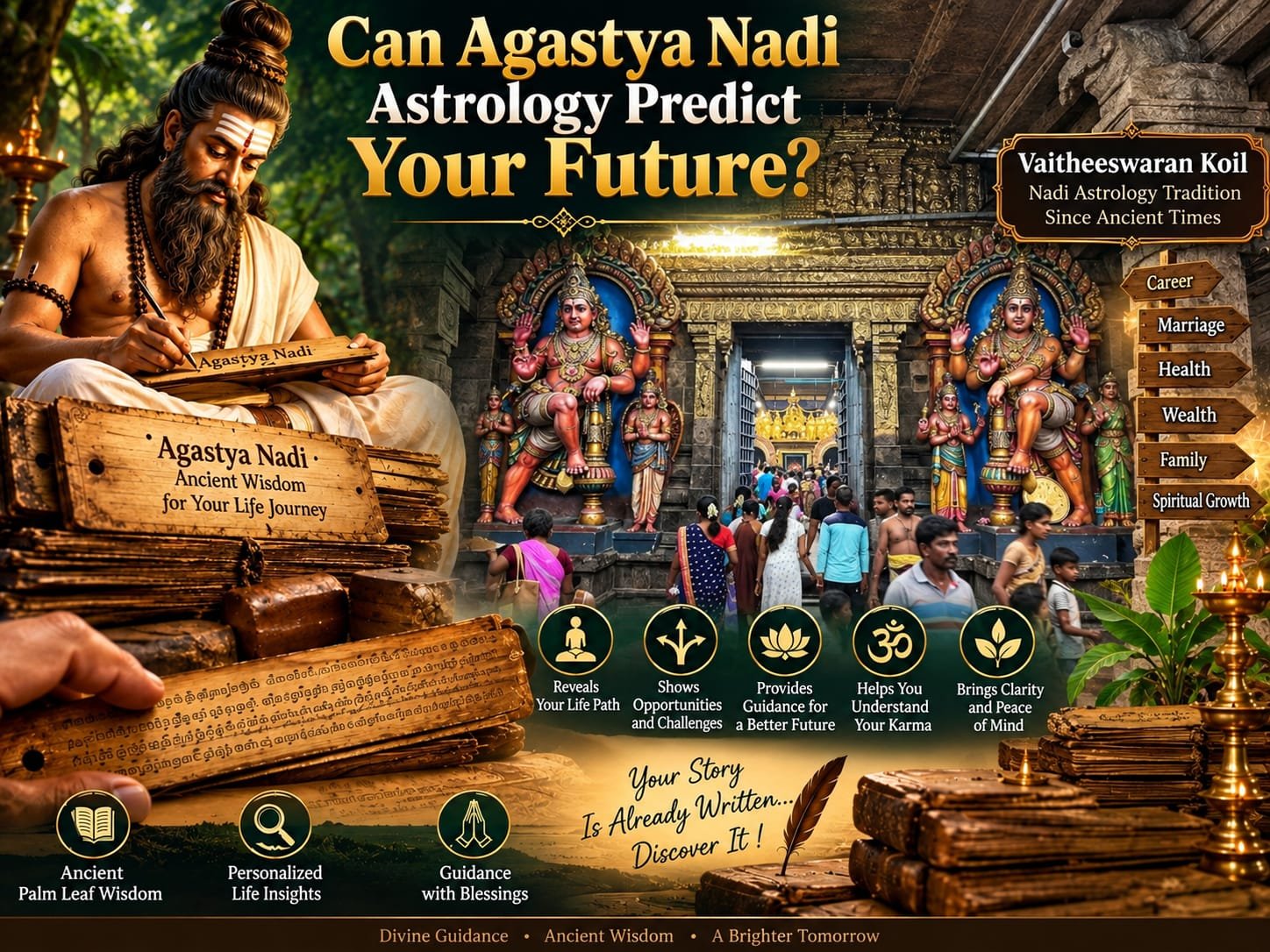
Agastya Nadi Astrology is an ancient spiritual tradition associated with palm-leaf manuscripts and the wisdom attributed to Sage Agastya. For people who approach this tradition, the idea of “predicting the future” is not simply about being told exactly what will happen tomorrow or receiving a fixed timetable for every event in life. Instead, a Nadi reading is traditionally understood as a way of exploring a person’s life journey, including possible patterns connected with family, education, career, marriage, finances, relationships, responsibilities, spiritual interests, and important turning points. According to the tradition, information was recorded on palm leaves for particular individuals, and the process of finding a relevant leaf may begin with details such as a thumb impression, followed by a series of identification questions. Once a matching manuscript is believed to have been identified, the reader interprets the material contained in the leaf and explains its traditional meaning. This is why many people see Agastya Nadi Astrology not merely as fortune-telling, but as a form of traditional guidance that encourages reflection on the direction of their lives.
One of the most interesting ideas within Nadi Astrology is the relationship between destiny and personal choice. A prediction does not necessarily have to be understood as an unavoidable event carved permanently into the future. Life is influenced by many factors, including our decisions, opportunities, relationships, circumstances, education, effort, and unexpected events. From a spiritual perspective, Nadi Astrology is often connected with the concept of karma—the idea that actions and their consequences may shape a person’s experiences. A traditional reading may therefore describe certain tendencies or periods that are considered significant while also encouraging the individual to think carefully about how they respond to those circumstances. In this sense, a Nadi reading can be approached as a map rather than an unchangeable command. A map may suggest possible directions, but the traveller still has to make choices along the journey.
The ancient palm leaves are central to the identity of this tradition. Historically, palm leaves were widely used as writing materials in South India, and manuscripts containing subjects such as literature, medicine, philosophy, religion, astronomy, and astrology were preserved in this form. Nadi Astrology developed within this broader manuscript culture and became particularly associated with certain centres in Tamil Nadu. Vaitheeswaran Koil is especially well known in popular Nadi traditions, where visitors have long sought palm-leaf readings. The atmosphere surrounding the practice—old manuscripts, traditional methods of identification, spiritual symbolism, and generations of readers—gives Nadi Astrology its distinctive character. For believers and visitors, discovering a manuscript believed to correspond to their life can feel deeply personal. However, the historical existence of palm-leaf manuscripts should be distinguished from scientifically demonstrating that a particular manuscript can reliably predict an individual’s future.
A traditional Nadi consultation may cover several areas of life rather than concentrating on one question. Career may be discussed in terms of professional direction, responsibilities, changes, or periods of opportunity. Marriage and family discussions may focus on relationships and household life. Financial sections may describe periods traditionally interpreted as favourable or challenging. Other parts may concern education, property, travel, parents, children, or spiritual development. Some Nadi traditions divide readings into sections commonly called Kandams, with each section focusing on particular aspects of life. The exact structure and interpretation can vary depending on the tradition and practitioner. For this reason, two consultations should not automatically be expected to follow precisely the same procedure or produce identical interpretations.
When someone asks whether Agastya Nadi Astrology can truly predict the future, it is useful to separate traditional belief from scientifically established evidence. Astrology, including Nadi Astrology, has not been scientifically demonstrated to predict individual future events reliably. Therefore, statements from a reading should not be treated as guaranteed facts. This distinction does not prevent someone from exploring the practice for cultural, spiritual, historical, or personal reasons. It simply means that predictions should be understood within the belief tradition from which they come. Important decisions involving medical treatment, education, money, legal matters, marriage, or employment are better made using reliable information, appropriate professional advice, and the individual’s own judgment rather than depending solely on an astrological prediction.
Another reason people are attracted to Nadi Astrology is the opportunity for self-reflection. Sometimes hearing a structured account of themes such as responsibility, relationships, goals, difficulties, and personal growth encourages a person to examine their life from a different perspective. A reading may prompt questions such as: What direction am I currently following? Which responsibilities have I been avoiding? What opportunities should I prepare for? Which relationships deserve more attention? What habits could I improve? These questions can have value even when the predictions themselves are treated cautiously. In this way, the experience may become less about waiting for destiny to arrive and more about considering how present choices can influence future possibilities.
The concept of karma also gives Agastya Nadi Astrology a strongly spiritual character. Within Indian philosophical traditions, karma is generally connected with actions and consequences, although different traditions explain it differently. In Nadi practice, interpretations may connect present circumstances with karmic themes and may sometimes include traditional spiritual recommendations. These should be understood as religious or cultural practices rather than scientifically proven methods for changing future events. For someone who follows the tradition, such practices may carry devotional significance and provide a sense of discipline, reflection, or spiritual connection. For someone approaching Nadi Astrology primarily from a historical or cultural perspective, the same elements can be understood as part of the heritage surrounding the practice.
The enduring appeal of Agastya Nadi Astrology may therefore come from something broader than prediction alone. It brings together ancient manuscript culture, astrology, spirituality, ideas about karma, personal storytelling, and the human desire to understand what may lie ahead. The image of an old palm leaf containing information connected to an individual’s journey naturally creates curiosity. People often want certainty about their career, relationships, family, finances, and future, especially during periods of change. Nadi Astrology offers a traditional framework through which those uncertainties can be explored, while modern understanding reminds us that the future cannot be guaranteed through an astrological reading.
Ultimately, the question “Can Agastya Nadi Astrology Predict Your Future?” has two different answers depending on the perspective being considered. Within the Nadi tradition, practitioners and believers may regard palm-leaf readings as revealing aspects of destiny, karma, and possible future developments. From a scientific standpoint, there is not reliable evidence establishing Nadi Astrology as a method capable of accurately predicting an individual’s future. A balanced approach is therefore to appreciate its cultural and spiritual significance without treating every prediction as certain. The future is affected by circumstances that cannot always be anticipated, but it is also shaped by choices made in the present. A Nadi reading may offer a traditional story about where the road could lead; the responsibility for deciding how to travel that road remains with the individual.